From the Meiji to the Taisho period in Japan, a dietary practice known as the “32-chew method” briefly attracted attention.
The idea was based on Horace Fletcher, an American businessman and health reformer. In his 1913 book Fletcherism: How I Became Young at Sixty, he argued that “chewing well creates health,” a claim that gained widespread attention at the time.
The idea that chewing improves health
Fletcher’s dietary method recommended chewing each bite of food about 32 times.
The reasoning behind this was that thorough chewing stimulates saliva production, which helps digestion and improves nutrient absorption.
Later studies also suggested that increased chewing may naturally reduce food intake by activating satiety signals in the brain, potentially helping to prevent overeating.
As a result, “Fletcherism” was introduced to Japan and gradually spread as a health practice among some segments of the population.
“Chewing” as part of school education
In Japan at the time, chewing was not only seen as a personal health habit but was also incorporated into school education.
For example, the predecessor of Lion Corporation, the Kobayashi Shoten Oral Hygiene Department, dispatched lecturers to kindergartens, elementary schools, and junior high schools to conduct hygiene education activities. Within these programs, “chewing food well” was taught as an important daily habit for children. Eating behavior itself became a subject of education.
Furthermore, this idea expanded into broader public health campaigns.
In 1931 (Showa 6), during the 4th “Tooth Decay Prevention Day” organized by the Japan Dental Association, the slogan “Good teeth, good chewing” was adopted. This emphasized chewing not merely as a personal habit, but as a form of lifestyle guidance aimed at protecting children’s health. In this way, chewing became embedded in school education and public hygiene movements.
Dietary design for growing students
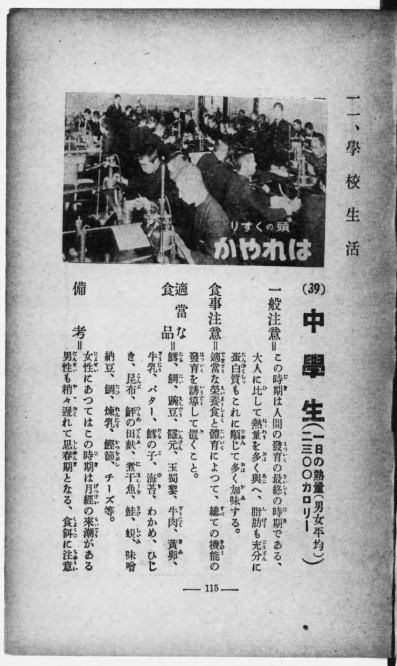
Alongside this, materials for junior high school students at the time included nutritional meal diagrams and a standardized three-day meal plan.
In these plans, white rice was often replaced with partially milled rice such as germ rice or 50% milled rice. Meals were designed with a balanced intake of carbohydrates, fats, and proteins in mind. In addition, a variety of Japanese, Western, and Chinese dishes were incorporated, reflecting a comprehensive approach to nutrition during adolescence.
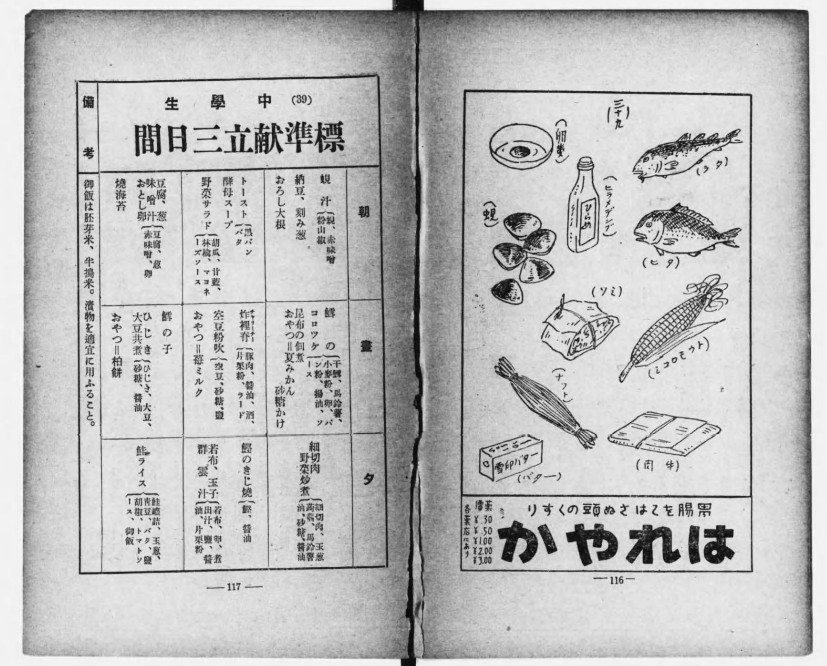
Breakfast: Rice, shijimi clam soup, natto (fermented soybeans) with green onions, grated daikon radish.
Lunch: Rice, taro croquettes, simmered kelp (kombu) tsukudani.
Snack: Summer orange (natsumikan) with sugar.
Dinner: Rice, stir-simmered thinly sliced meat and vegetables.
The transformation of Fletcherism
As time progressed, Fletcherism took on a different meaning.
Originally promoted as a method for improving health and preventing overeating, it later became associated with wartime ideas of food conservation. The concept of “chewing more and eating less” was incorporated into broader lifestyle guidance as a rational approach to reducing food consumption during periods of scarcity.
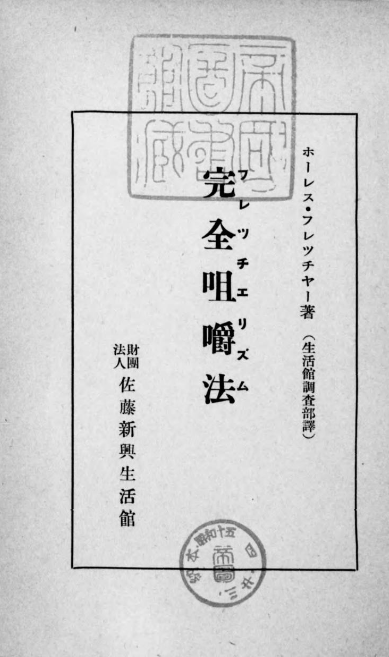
Fletcher’s ideas were later compiled in Japan in a book titled Perfect Chewing Method, published in 1940. This illustrates how health theories can change in meaning depending on social and historical context.
The modern legacy of “chewing well”
Even today, “chewing well” is widely recognized as a healthy eating habit.
Modern research has supported some of its benefits, including improved digestion and increased meal satisfaction, though it is now understood within a more scientific framework.
Despite changes in interpretation over time, the simple act of chewing continues to remain an important part of how we think about food and health.
Refarences
Horace Fletcher et al., Perfect Chewing Method, Sato Shinkō Seikatsukan, 1940. National Diet Library Digital Collections
https://dl.ndl.go.jp/pid/1078483 (accessed May 7, 2024)
Occupational Nutritional Meal Diagrams
Ryori no Tomo-sha, 1935 (Showa 10). National Diet Library Digital Collections
https://dl.ndl.go.jp/ja/pid/1096559/1/63 (accessed June 29, 2026)

Comment