1. Introduction
When people hear the word kamishibai, they often think of children’s entertainment. In reality, however, kamishibai was much more than that. It was one of the most important forms of visual media in modern Japan. Before movie theaters and television became common, how did people experience stories through images?
2. What Was Kamishibai?
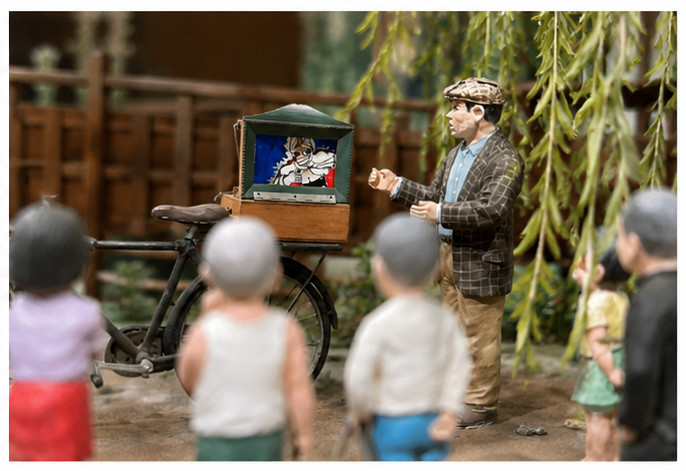
Kamishibai became popular as a form of street storytelling that combined narration with illustrated picture cards. A storyteller placed the cards inside a small wooden frame mounted on a bicycle and pulled them out one by one as the story unfolded.
But the illustrations alone were not enough. The real heart of kamishibai was the storyteller.
3. The Storyteller: The Real Director
Although kamishibai consisted of a series of still images, it was the storyteller who made them feel alive.
The storyteller controlled the pace with changes in voice, dramatic pauses, suspense, and interaction with the audience. The very same picture cards could become completely different stories depending on who was performing. In that sense, kamishibai was less a finished work than a live performance.
4. Candy Sales and the Children
Street kamishibai performances were almost always accompanied by the sale of inexpensive sweets.
This was more than a simple bonus. Children gathered to watch the performance and, while enjoying the story, bought candy from the storyteller. Kamishibai combined storytelling, business, and attracting an audience into a single system.
5. Kamishibai: A “Motionless Movie”
Unlike a film, the pictures in kamishibai never moved. Yet in the audience’s imagination, they certainly did.
It was not the pictures that created movement, but the storyteller’s voice. Instead of moving images on a screen, it was the audience’s imagination that completed the story. Kamishibai represented a unique visual culture, different from both cinema and television.
6. The Connection with Magic Lantern Shows
Around the same time, another popular form of visual entertainment was the magic lantern show, which projected images using light.
As seen in the works of Kenji Miyazawa, people of this era were deeply fascinated by stories presented through projected images.
- Magic lantern shows: indoor storytelling through projected light.
- Kamishibai: outdoor storytelling brought to life through narration.
Both offered memorable visual experiences before the age of cinema.
7. The Road to Modern Visual Media
Kamishibai formed part of the long evolution that eventually led to movies and television.
Magic lantern shows, kamishibai, cinema, and television were not simply stages of technological progress. They also reflected changing ways in which people experienced stories through images.
8. Conclusion
Kamishibai was far more than entertainment for children.
It brought together skilled storytelling, clever business practices, and the audience’s imagination. In many ways, it was a “motionless movie”—a distinctive form of media culture that played an important role in modern Japan.
Comment