What Did People Watch and Enjoy Before Electricity?
Today, when we think of visual entertainment, we often think of things powered by electricity—television, movies, smartphones, and other digital media.
But the culture of enjoying things by looking at them did not begin with the invention of electricity.
Long before movies and television appeared, people in Japan enjoyed stories and imaginary worlds through paintings, light, shadows, and a variety of ingenious devices.
These experiences were not simply about receiving information. People gathered together, listened to stories, were surprised, laughed, and shared their emotions with one another. In other words, they were part of a rich culture of watching and experiencing images together.
In this article, we will explore how people in Japan enjoyed images and visual entertainment before the age of cinema and television.
Enjoying Stories Through Pictures
People have long enjoyed imagining entire worlds within a single picture.
In Japan, a rich culture of storytelling through images developed over many centuries.
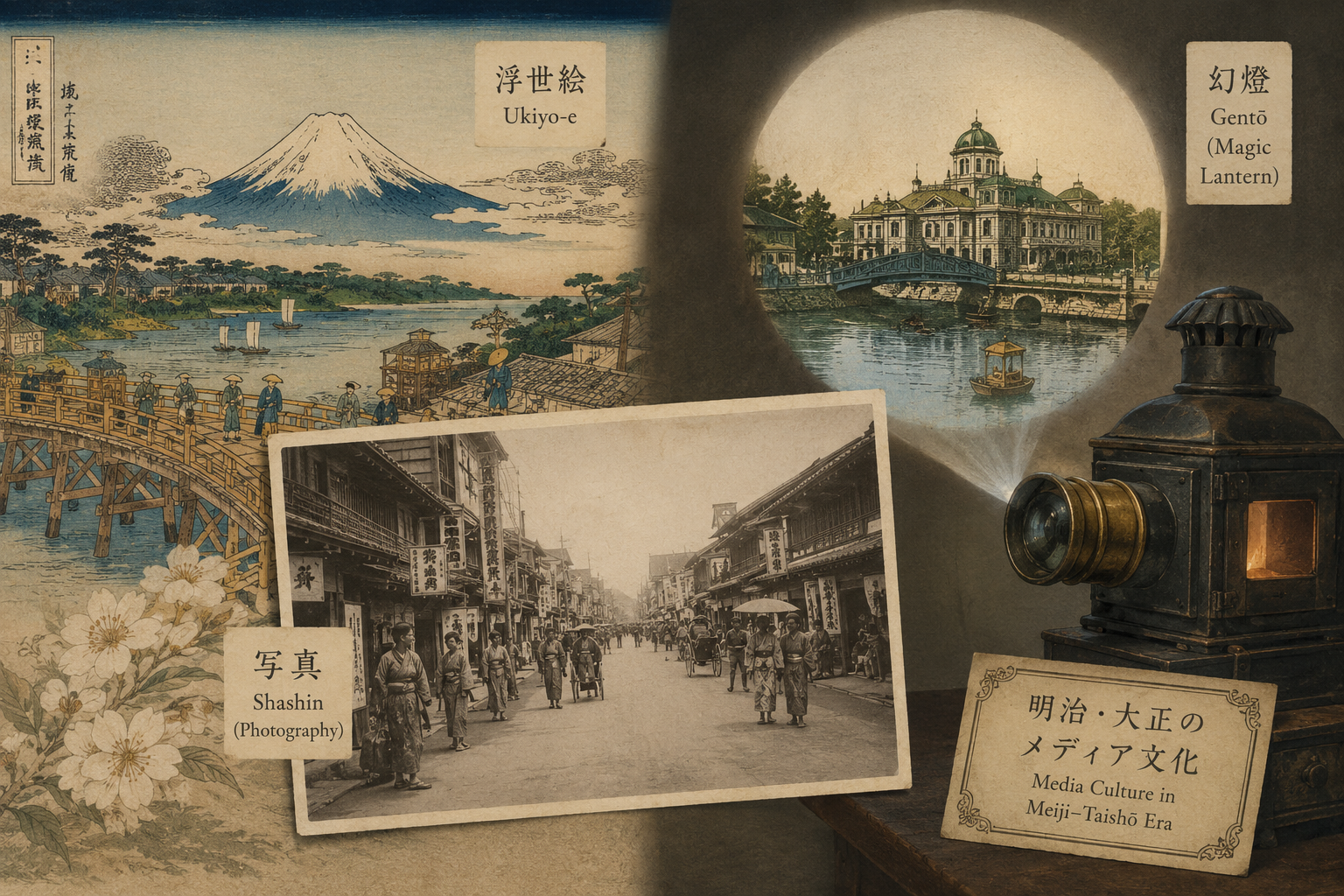
In illustrated handscrolls, viewers followed both pictures and text as a story unfolded. During the Edo period (1603–1868), ukiyo-e and multicolored woodblock prints became popular forms of entertainment among ordinary people.
Ukiyo-e depicted a wide range of subjects that captured the interests of people at the time, including beautiful women, kabuki actors, famous places, and the latest fashions.
Looking at a print could be a form of entertainment in itself. People might imagine the stories behind the figures, learn about current trends, or simply admire the beauty of the scene.
Picture books and illustrated popular fiction also played an important role in bringing stories to a wider audience.
By looking at a single image, people could read expressions, imagine what was happening, and allow the story to unfold in their own minds.
In this sense, the pleasure of looking at pictures was already connected to the visual culture that would develop later.
Photography Brings a New Way of Seeing
From the late Edo period into the Meiji period, photography began to spread in Japan.
People could now see not only imagined or artistically created worlds, but also actual people and places captured in photographs.
Photography was used for many purposes, including portraits, records, and news reporting, and it became an important new form of media in modern Japan.
Photographs could also become objects of entertainment in their own right.
For example, photographs of famous beauties could be collected, displayed, and even compared. People could enjoy looking at photographs in much the same way that they had enjoyed images of beautiful women in ukiyo-e.
The desire to look at beautiful people and beautiful things continued, even as the medium changed—from woodblock prints to photographs.
Devices Created for the Pleasure of Seeing
People did not simply look at pictures. They also invented ways to make the experience of looking more exciting.
In shadow play, light and shadows were used to create figures and animals, sometimes giving the impression of movement.
In utsushi-e, images were projected using light and presented as part of performances that combined pictures, storytelling, and theatrical effects.
There were also nozoki karakuri, viewing boxes that allowed people to look through a small opening and see miniature scenes of places and worlds they could not normally experience.
These forms of entertainment were not simply about looking at a picture.
They involved thinking about how a picture could be presented and how the act of looking itself could become an exciting experience.
Little by little, the pleasure of looking at pictures developed into the pleasure of experiencing images through light, shadows, and mechanical devices.
Magic Lanterns(Gento) — Images Appearing in the Darkness
An image suddenly appears in a darkened room, glowing with light.
Before the invention of cinema, people experienced moving and projected images through the magic lantern.
A magic lantern was a device that used light to project images painted or photographed on glass plates onto a wall or screen.
In Japan, magic lantern shows had already been enjoyed as public entertainment during the Edo period. During the Meiji era, their uses expanded even further. Magic lanterns became part of everyday life in many different ways—from inspiring women to imagine the future to being used in schools and lectures to share knowledge.
But the appeal of the magic lantern was not limited to the images themselves.
People gathered in a darkened room and watched the same images appear on a screen while listening to a narrator. They experienced surprise, laughter, and emotion together.
In this sense, magic lantern shows offered an experience that would later become familiar in movie theaters: watching images together as a group.
You can learn more about how magic lanterns were received and used in Meiji-era Japan in the following articles:
- Magic Lanterns and the Dreams of Meiji Women
- Magic Lanterns for Education
- Miyazawa Kenji and the Magic Lantern
Magic lanterns were more than simply a technology that came before cinema.
In the darkness, people gazed at images made of light and projected their own stories, knowledge, and visions of the future onto them.
They were one of the starting points of Japan’s modern visual culture.
Moving Images and the Birth of Cinema
As the use of electricity spread, visual culture began to change dramatically.
New technologies made it possible to project moving images, and by the late Meiji and early Taisho periods, katsudo shashin, or “moving pictures,” were attracting widespread attention.
Movie theaters offered a new kind of entertainment. Large audiences could sit together, watch a screen, and become immersed in a fictional world.
But cinema did not appear out of nowhere.
People had already spent centuries enjoying pictures, looking at photographs, being amazed by images projected with light, and gathering together to share stories.
Cinema emerged from this long history of visual experiences.
The Culture of Visual Storytelling After Cinema
Even after cinema became popular, older forms of visual entertainment did not simply disappear.
One example was kamishibai, or picture-story shows.
Children gathered on street corners and listened as a storyteller presented a series of illustrated cards, changing the pictures while telling the story.
Kamishibai was not complete without the performer.
The storyteller’s voice, the timing of each picture change, the children’s reactions, and the atmosphere of the gathering all became part of the experience.
Like magic lantern shows, kamishibai brought people together to enjoy a story at the same time and in the same place.
Even after movies appeared, the desire to gather together, look at pictures, and enjoy stories did not disappear.
Conclusion
Visual culture did not begin with electricity.
For centuries, people had enjoyed:
• imagining stories through pictures
• admiring beautiful people and landscapes
• being fascinated by light and shadows
• sharing images with others
• experiencing stories through pictures and narration
The ways people enjoyed looking changed over time.
From illustrated handscrolls and ukiyo-e to photography, shadow play, viewing devices, magic lanterns, and eventually moving pictures, each new form grew from earlier ways of seeing and experiencing images.
And even after cinema appeared, traditions such as kamishibai continued.
Movies were not a completely new form of entertainment that suddenly appeared one day.
They emerged from a much longer history—a history in which people had gradually developed a desire to see, imagine, share, and experience stories through images.
Even before electricity, people in Japan had already created a rich and fascinating culture of seeing.
References
• The Illustrated History of Magic Lantern Slides: The Archaeology of Projection Media, edited by the Tsubouchi Memorial Theatre Museum, Waseda University, Seikyusha, 2015.
• Kenji Iwamoto, Visual Culture in Japan Before Cinema, Mori Shobo, 2002.