When you think of Japanese New Year’s food, what comes to mind?
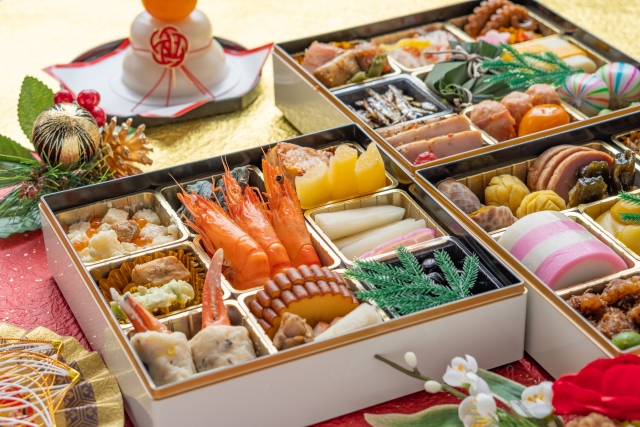
Black soybeans, herring roe, sweet chestnut paste, and datemaki rolled omelets? Many people probably picture osechi ryori, a colorful assortment of dishes neatly arranged in stacked lacquered boxes.
When I think of New Year’s, I remember preparing for the holiday with my family. My mother was in charge of cooking and was always busy in the kitchen. As I grew older, I began helping out, peeling vegetables and mashing ingredients.
My favorite tasks were making decorative cuts in konnyaku and kamaboko, a type of fish cake. I loved making a cut in the middle, then passing one end through it to create a twisted pattern.
But one day, I found myself wondering about something.
When did osechi ryori take on the form we recognize today?
Have people always prepared the same dishes and arranged them in stacked boxes in the same way? This time, I will explore the changing history of osechi ryori, drawing on research into women’s magazines published in modern Japan.
New Year’s Food in the Edo Period and the Tradition of Kuizumi
Today, when we think of osechi ryori, we generally imagine a variety of dishes packed into tiered boxes.
In the past, however, people also observed a New Year’s custom known as kuizumi. This involved arranging food in piles and was associated with festive New Year’s displays as well as hospitality for people who visited to exchange New Year’s greetings.
The term osechi also originally referred to dishes associated with seasonal festivals and turning points in the year, rather than being limited to New Year’s cuisine.
Cookbooks and accounts of everyday life from the Edo period describe dishes prepared for the New Year and explain how they were made. Foods such as herring roe, tazukuri (dried sardines simmered in a sweet soy-based glaze), tataki gobō (pounded burdock root), and simmered beans were already used in New Year’s assortments, and many remain familiar components of osechi today.
However, the fact that some of the same dishes were served does not necessarily mean that the contents and arrangement of the boxes were identical to those we see today.
So how did the modern form of osechi ryori develop?
New Year’s Assortments Appear in Meiji-Era Magazines
An important resource for exploring this question is Shin’ya Yamada’s academic paper, “The Formation of Osechi Ryori in Modern Japan and Women’s Magazines.”
Yamada examines how osechi ryori changed over time, focusing on three women’s magazines: Fujin no Tomo, Fujin Gahō, and Shufu no Tomo.
According to his research, the December 1910 issue of Fujin Gahō featured a New Year’s assortment titled “Shōchikubai Shōgatsu-yō Jūzume,” or “Pine, Bamboo, and Plum New Year’s Assortment.”
The ingredients included canned matsutake mushrooms, bamboo shoots, and arrowhead tubers (kuwai) cut into plum-blossom shapes. The matsutake represented pine, the bamboo shoots represented bamboo, and the plum-shaped arrowhead tubers represented plum. Together, they expressed the auspicious symbolism of shōchikubai—pine, bamboo, and plum.
I find this arrangement particularly fascinating.
It differs considerably from the osechi we know today, yet the idea of expressing New Year’s wishes through the shapes and names of ingredients is still familiar. The ingenuity behind this festive presentation has a distinctly modern counterpart.
The fact that such an arrangement appeared in a magazine also suggests that publications were providing households with ideas and inspiration for preparing New Year’s meals in modern Japan.
The Taisho Period: A Variety of Dishes in Tiered Boxes
Yamada’s paper also introduces New Year’s assortments featured in women’s magazines during the Taisho period.
According to his research, these assortments were not limited to combinations of traditional celebratory dishes, appetizers, and simmered vegetables. Some included boxes for sashimi and even boxes for soup—formats quite different from the osechi commonly seen today.
Furthermore, the January 1924 issue of Fujin no Tomo featured tiered boxes containing Western-style foods, including sandwiches and chicken jelly.
These examples suggest that New Year’s assortments of the time were not restricted to a fixed set of dishes. Some centered on Japanese cuisine, while others incorporated Western-style foods. There was considerable variety in both the menus and the ways the dishes were arranged.
This is what I find so interesting about the history of osechi ryori.
Today, we have certain expectations about which dishes belong in osechi and how they should be arranged in each tier of a box. But people in the past did not necessarily follow the same format we recognize today.
Even the forms we regard as traditional may have developed through a process of experimentation and change.
How Women’s Magazines Presented New Year’s Cuisine
Yamada’s research examines how modern osechi ryori took shape through recipes and menu ideas published in women’s magazines.
These dishes and arrangements would have provided readers with ideas for preparing for the New Year and entertaining guests. The magazines introduced not only menus but also ways to present food, evoke the season, and express auspicious wishes.
Such publications offer valuable clues to the different New Year’s food traditions practiced by individual households. They also played a role in introducing new dishes and ways of arranging them.
Of course, we cannot conclude that every dish featured in a magazine subsequently became popular throughout Japan. The menus presented in print must be distinguished from the dishes that people actually prepared in their homes.
Nevertheless, examining women’s magazines from the Meiji and Taisho periods allows us to see concretely how New Year’s assortments were presented and what kinds of creative ideas they incorporated.
Reading these historical sources has changed the way I think about tradition.
Passing down a custom does not necessarily mean preserving it exactly as it was. Adapting it to the circumstances of the time and incorporating new ideas may also be ways of keeping a culture alive.
Osechi Ryori Took Shape Over Time
Yamada’s paper shows that women’s magazines in modern Japan featured a wide variety of New Year’s assortments, including arrangements that differed from the osechi we know today.
While some dishes now associated with osechi were already used in New Year’s assortments during the Edo period, the Meiji and Taisho periods saw the introduction of diverse arrangements, from pine-bamboo-plum-themed dishes to assortments incorporating Western-style cuisine.
These examples suggest that the form of osechi ryori we recognize today has not remained completely unchanged throughout history.
Researching the history of osechi has led me to realize that tradition is not simply something handed down unchanged from the past. Rather, traditions can also take shape gradually as people build on longstanding dishes and customs, adapting them to the way they live in each era.
There is one more question I would like to explore.
We often hear that each osechi dish carries an auspicious meaning. Black soybeans, for example, symbolize living and working diligently, while herring roe represents prosperity and the continuation of the family line.
When did these explanations of the symbolic meanings of individual dishes become widespread in their present form?
Yamada’s paper provides an important starting point for understanding how New Year’s assortments developed in modern Japan. However, investigating when the auspicious meanings associated with individual dishes became widely established will require a different set of historical sources.
Exploring osechi ryori is not just about learning where particular dishes came from. It also offers an opportunity to consider how the things we regard as longstanding traditions have been passed down and shaped over time.
Reference
- Yamada, Shin’ya. “A Study of the Development of Japanese New Year’s Dishes in the Modern Times and Their Relationships with Women’s Magazines: A Case Study Focused on Fujin-no-Tomo , Fujin-Gahō , and Shufu-no-Tomo.” Bulletin of the National Museum of Japanese History, vol. 197, 2016, pp. 295–319.