I loved eating Christmas cake as a child, and before I knew it, I had started making cakes myself.
Baking a cake takes quite a bit of work, but I still remember the sweet aroma that fills the kitchen as it bakes and the happy faces of my family when they see the finished cake.
What Christmas memories do you cherish?
Today, many families celebrate Christmas with cake and a special meal. But how did people in Japan celebrate Christmas in the past?
This time, let’s take a look at Christmas at home from the Taisho era through the early Showa era, using cookbooks from the period as our guide.
A Festive Christmas Dinner
Mother’s Cooking (Haha no Ryori), written by Keiko Akiho and published in 1940 (Showa 15), features a Christmas menu.
The menu included:
- Cream soup
- Chilled salmon
- Macédoine salad
- Beef jelly
- Roast chicken
- Pudding
The meal featured an array of Western-style dishes, from cream soup and chilled salmon to salad, a beef dish, and roast chicken. Pudding was served at the end.
Macédoine salad is a salad made with vegetables and other ingredients cut into small cubes. According to the recipe, the beef jelly involved roasting beef before simmering it and serving it with tomato sauce. The cooking method is reminiscent of some modern braised meat dishes.
This menu suggests that Christmas was seen as an occasion for preparing something special and enjoying a meal that was different from everyday fare.
So, what did families do after dinner?
Gathering by the Stove After Dinner
One detail in Mother’s Cooking particularly caught my attention: its suggestions for spending time together after the meal.
The book recommends serving pudding as dessert after the meal. It also suggests gathering the children near the stove and having them tell stories or sing solo. Older children could even put on a little performance based on a beautiful story.
What a lovely way to spend Christmas!
Imagine the family gathered around a warm stove, with the children singing songs or acting out stories while the adults watch and enjoy the winter evening.
Unlike today, when families can turn to television and online videos for entertainment, the book encouraged families to create their own fun together.
Christmas was not simply a matter of enjoying a festive meal. The book presented it as an occasion for the children to take center stage and for the whole family to share a special time together.
Even a brief passage in a cookbook can help us imagine the warmth of family life in those days.
What Were Christmas Cakes Like in the Taisho Era?
When we think of Christmas, cake naturally comes to mind.
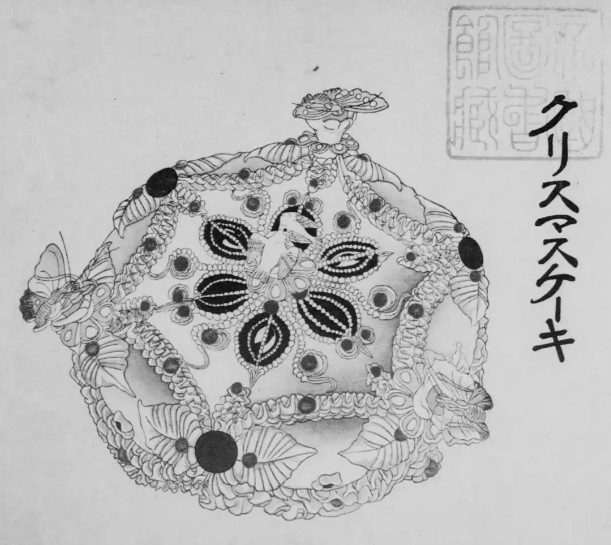
December Confectionery (Junigatsu Kashicho), written by Umejiro Furukawa and published in 1920 (Taisho 9), contains an illustration of a Christmas cake.
It shows a round, relatively flat cake decorated with elaborate designs. It looks quite different from the strawberry shortcake topped with whipped cream that is familiar to many people in Japan today.
The book explains that the cake base was to be made in the same way as a “plum cake.” For decoration, it describes covering the cake with what appears to be fondant, then adding candied fruits such as strawberries and lemons, along with dragées and cherries.
The illustration features patterns resembling lace and flower petals across the surface. Perhaps these were made with fondant or a similar icing. There is also a decoration that looks like a butterfly. It may have been made from pulled or molded sugar.
Unfortunately, I was unable to locate the recipe with the full instructions for making the cake base. Even so, it is fascinating to discover that cookbooks of the time already featured recipes and decorating ideas for Christmas cakes.
Today, many people in Japan picture a strawberry shortcake with whipped cream when they think of Christmas cake. Yet this Taisho-era confectionery book preserves a different vision of the Christmas cake, decorated with candied fruits and other embellishments.
Christmas Cakes in the Early Showa Era
What other kinds of Christmas cakes were being made during this period?
Akahori’s Western Cooking (Akahori Seiyo Ryoriho), written by Minekichi Akahori and published in 1929 (Showa 4), includes a recipe under the heading “Christmas Cake.”
The recipe calls for ingredients such as raisins, almonds, and candied fruit. Judging from the ingredients, the cake seems similar in style to the fruit cakes we know today.
It offers a different appeal from the cake illustrated in December Confectionery, which was decorated with candied fruits, dragées, and other embellishments.
Of course, the fact that these cakes appeared in cookbooks does not necessarily mean that they were widely made in ordinary households at the time. Nevertheless, it is fascinating to see how recipes for cakes intended to celebrate Christmas were being introduced through cookbooks from the Taisho era into the early Showa era.
Celebrating Christmas with Family: Then and Now
The 1940 cookbook Mother’s Cooking offers a glimpse of Christmas at home: a Western-style festive meal followed by children singing songs and sharing stories.
Meanwhile, a Taisho-era confectionery book contains an illustration of a Christmas cake, and a cookbook from the early Showa era features a recipe for one.
Food and sweets have changed over time. Yet perhaps the desire to gather around a table with loved ones and enjoy a special moment together has remained much the same.
This Christmas, why not try making a cake at home? Singing together or sharing stories after dinner could also make the evening feel a little different from usual.
Perhaps I’ll bake a cake myself for the first time in a while.
References
- Akiho, Keiko. Haha no Ryori (Mother’s Cooking), vol. 8 of Haha no Bunko. Fujokai-sha, 1940, p. 234. National Diet Library Digital Collections.
Furukawa, Umejiro. Junigatsu Kashicho (December Confectionery). Furukawa Umejiro, 1920. National Diet Library Digital Collections. - Akahori, Minekichi. Akahori Seiyo Ryoriho (Akahori’s Western Cooking). Okura Shoten, 1929, p. 560. National Diet Library Digital Collections.