When I was a child, special Christmas-themed anime episodes were broadcast as Christmas approached. Snowy landscapes, towns decorated for the holiday, and people exchanging presents filled me with excitement. I was a child with a big appetite, so what I looked forward to most was the cake.
Even today, as Christmas approaches, streets light up with illuminations, and shops display Christmas trees and gifts. Regardless of their religious beliefs, many people in Japan enjoy Christmas as a seasonal celebration.
But how did Christmas become so popular in Japan?
Christmas had already been introduced to Japan alongside Christianity during the Warring States period. In the Meiji era, however, it began to attract public attention again. Books featuring Santa Claus were published, and shops in Ginza drew people’s attention with festive decorations. By the Taisho era, Christmas had also begun appearing in magazines for children.
In this article, we will explore historical materials from the Meiji and Taisho eras to see how Christmas gradually became part of Japanese life.
Santa Claus, Known as “Santakuro”
Today, Santa Claus is a familiar figure, but in Meiji-era Japan, not everyone knew his name or what he looked like.
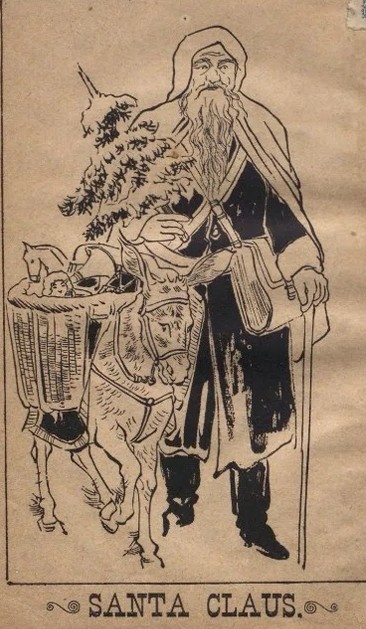
In December 1900, a book titled Santakuro was published by Kyobunkan. Written by Nobuyoshi Shindo, who used the pen name Kaede, the book is recorded in the National Diet Library’s catalog.
The name Santakuro can be written in Japanese characters as 三太九郎. The figure depicted in the book differed somewhat from the Santa Claus we know today. According to an explanation by the Japan Toy Museum, he was accompanied by a donkey and carried a Christmas tree and a staff.
At the time, neither the name Santa Claus nor his familiar image was as widely known in Japan as it is today. Christmas was still a foreign custom being gradually introduced to Japanese readers.
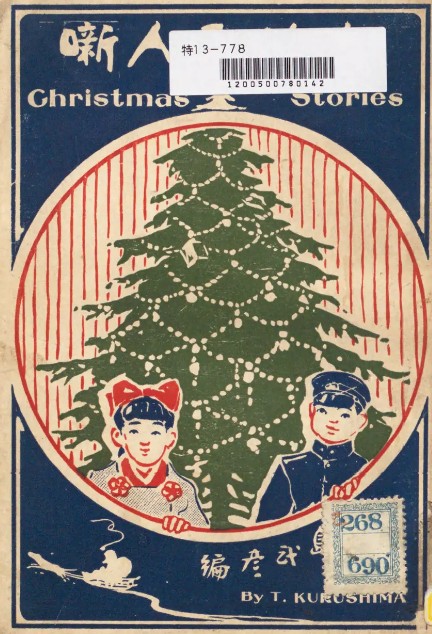
Other books related to Christmas were also published during the Meiji era. One example is Otogi Goninbanashi, edited by Takehiko Kurushima and published by Kyobunkan in December 1911.
By examining these books individually, we can find clues about how Christmas was introduced and presented to people in Japan.
Meijiya and Christmas in Ginza
Shops also played an important role in introducing Christmas to the public.
Toward the end of the Meiji era, shops in Ginza, Tokyo, began decorating their premises for Christmas as part of their year-end sales campaigns.
An article in the eighth issue of the magazine Home, published in 1906, describes how Meijiya and Kameya, shops along Ginza’s main street, attracted passersby with festive decorations designed to draw in Christmas shoppers. Toys and sweets for children were among the main attractions.
For people who had never heard of Christmas, or who did not celebrate it in church, these colorful displays must have been eye-catching.
Christmas was becoming familiar not only through books and religious settings but also through shops and the streets of the city. Some people may have become curious about the holiday simply by seeing the decorations in shop windows.
Such commercial displays likely helped establish Christmas as an enjoyable part of the year-end season.
In the Taisho Era, Christmas Reaches Children
Christmas, which had begun spreading through shop decorations and other displays in the Meiji era, also started appearing in children’s publications during the Taisho era.
The children’s magazine Kodomo no Tomo (A Friend of Children) is one source that offers a glimpse of this development. Its December 1914 issue featured an illustration of Santa Claus and a story titled “Santa Claus no Kaimono” (“Santa Claus’s Shopping Trip”).
Christmas was becoming more than a festive attraction in shop windows. Through stories and illustrations, it was also becoming a holiday that children could enjoy and relate to.
When I was a child, television also aired Christmas-themed anime as the holiday approached. The snowy landscapes and beautifully decorated towns on the screen filled me with excitement. Of course, what I looked forward to most was the cake.
I wonder whether children in the Taisho era felt the same excitement when they looked at the Christmas scenes in their magazines. Imagining that makes children who lived more than a century ago feel a little closer to me.
Christmas Becomes a Source of Joy
During the Meiji era, books featuring Santa Claus were published, and shops in Ginza attracted attention with their Christmas decorations. By the Taisho era, Christmas had also begun appearing in magazines for children.
These historical materials suggest that Christmas did not spread throughout Japan all at once. Instead, people gradually became familiar with it through books, shops, magazines, and other forms of media.
Christmas today is also surrounded by a variety of festive influences, from illuminated streets and shop displays to television programs and magazines. As the season approaches, the excitement I felt as a child comes back to me. Perhaps I am not the only one who feels that way.
Looking back at materials from the Meiji and Taisho eras reminds us that even the Christmas scenes we now take for granted have their own history in Japan.
What did Christmas celebrations look like in ordinary Japanese households? I’ll explore that in the next article.
References
- Klaus Kracht and Katsumi Tateno-Kracht, Christmas: How Did It Become Established in Japan? Kadokawa Shoten, 1999.
- Hajime Ishikawa, “The Reception of Western Culture in Japan Through Christmas,” Komazawa Women’s University, Japanese Culture Essay, December 19, 2022.
- Asato Izumi, “Ginza Advertisements in 1911,” GINZA OFFICIAL, July 25, 2016.
- Nobuyoshi Shindo (Kaede), Santakuro, Kyobunkan, December 1900. National Diet Library Digital Collections.
- Edited by Takehiko Kurushima, Otogi Goninbanashi, Kyobunkan, December 1911. National Diet Library Digital Collections.