Toshikoshi Soba: A New Year’s Eve Tradition in Japan
In the anime Laid-Back Camp Season 2, the characters enjoy soba noodles while camping over New Year’s. A warm bowl of soba on a cold night looks delicious.
Today, eating soba on New Year’s Eve is a familiar way to say goodbye to the old year in Japan.
But did people in the Meiji era enjoy toshikoshi soba in the same way?
Tokyo Nenju Gyoji, a book published in 1911, offers an interesting look at New Year’s Eve in Tokyo at that time.
The Soba Never Arrived! A Busy New Year’s Eve in Meiji-Era Tokyo
In Tokyo Nenju Gyoji, Volume 2, Wakatsuki Shiran describes the city on New Year’s Eve.
The streets were busy, and soba shops were overwhelmed with orders.
Some people ordered soba in the morning, hoping to eat it with their evening meal. Yet the noodles did not arrive on time. Even after asking the shop several times, they still had to wait. Some people who ordered soba late in the afternoon reportedly had to wait until the bells rang in the New Year, and their noodles still had not arrived.
That is how busy soba shops in Tokyo could be on New Year’s Eve in 1911.
People wanted to eat soba before the year ended, and both shopkeepers and delivery workers had their hands full. The account suggests that eating soba on New Year’s Eve was already firmly established in Tokyo.
Even today, soba shops prepare for the year-end rush by taking reservations and offering takeaway noodles. People look forward to their soba, while the shops work hard to meet the demand. In this way, some scenes of New Year’s Eve may not have changed much over time.
New Year’s Eve Soba in the Edo Period
The tradition of eating soba on New Year’s Eve goes back further than the Meiji era.
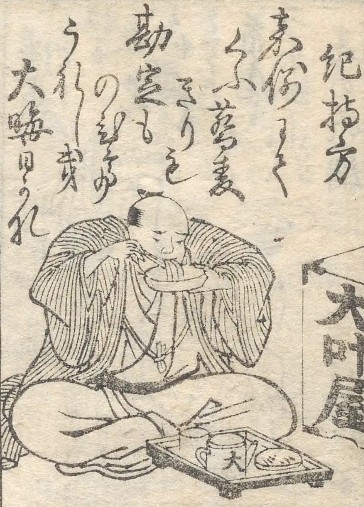
A book published in 1793, Dore Hyakunin Isshu, includes an illustration of people eating soba on New Year’s Eve, along with this humorous poem:
Karei nite kuu sobakiri mo kanjo nobite ureshiki omisoka kana
The poem describes eating soba as a customary year-end practice. The phrase karei refers to a customary or auspicious practice.
The meaning of kanjo nobite needs to be considered in its original context, so it is best not to draw a firm conclusion about the phrase. Still, the illustration and poem show that eating soba on New Year’s Eve was a familiar custom in the Edo period.
The 1793 illustration and the account published in 1911 offer two glimpses of this tradition. Together, they show that soba was part of New Year’s Eve life in Japan long before the modern era.
Why Do Japanese People Eat Soba on New Year’s Eve?
There are several explanations for the tradition of toshikoshi soba.
One well-known explanation is that the long, thin noodles represent a wish for a long life. Another says that, because soba noodles break more easily than some other noodles, they symbolize leaving behind the hardships and misfortunes of the old year.
There is also a story that goldsmiths used soba flour to collect scattered gold dust. This has been linked to the idea of good fortune and wealth.
However, these are traditional explanations rather than a single, proven origin. It is difficult to say that any one of them is the definite reason the custom began.
Perhaps the tradition grew from the wish to welcome the New Year with hopes for good health and good fortune.
Did Everyone Eat Soba on New Year’s Eve?
Historical records show that soba shops were extremely busy on New Year’s Eve. But does that mean everyone ate toshikoshi soba?
Even today, people have different ways of spending the last day of the year. Some enjoy soba, while others prefer different dishes or simply go about their usual routines.
Soba shops can become crowded on New Year’s Eve. Some people may dislike the crowds or the unusual atmosphere of a shop on such a busy day. Perhaps they would rather visit on another day and enjoy their soba in peace.
At present, however, I have not found a specific historical record showing that people in Meiji-era Japan avoided New Year’s Eve soba shops for these reasons.
Still, the account of the busy shops makes us wonder whether everyone welcomed the excitement. Some people may have preferred a quieter end to the year.
The fact that a custom was widely practiced does not mean that everyone enjoyed it in the same way. Even in a city where New Year’s Eve soba was popular, people may have had different ways of spending the evening.
What Soba Tells Us About Life in the Past
The humorous poem from 1793 depicts soba on New Year’s Eve. The account from 1911 describes shops struggling to keep up with orders.
Together, these sources offer glimpses of a tradition that was part of everyday life across different periods of Japanese history.
Learning about toshikoshi soba is not just about discovering the origins of a food tradition. It also helps us imagine how people spent the final day of the year and what they hoped for as a new year began.
I also eat toshikoshi soba at the same shop every year. Whenever I enjoy my usual bowl of soba, I feel that the year is coming to an end.
I wonder if people in the Edo and Meiji periods also enjoyed their soba as they said goodbye to the old year, each with their own thoughts and feelings.
References
- Wakatsuki Shiran, Tokyo Nenju Gyoji, Volume 2. Shun’yodo, 1911. Source:National Diet Library Digital Collections.
- Edited by Shikatsube Magao, Dore Hyakunin Isshu, 1793.Source:National Diet Library Digital Collections.