When we hear the Japanese expression momiji-gari, or “autumn leaf hunting,” it may sound a little strange.
Are autumn leaves really something we can “hunt”?
We do not chase them through the mountains like deer or birds.
And yet, every autumn, people in Japan still say, “Let’s go momiji-gari.”
If we look more closely at the word kari, or “hunting,” we can see an older way of enjoying the seasons: going out to look for beautiful things in nature and bringing something home.
“Hunting” Was Not Only for Animals
In the past, the word “hunting” could also describe going into the mountains and fields to look for things that belonged to a particular season.
A good example can be found in Hojoki, written by Kamo no Chomei in the Kamakura period (1185–1333).
Chomei lived in a small hut in the mountains. On fine days, he walked through the mountains and visited temples and historic sites.
On his way home, he wrote that he would:
“hunt for cherry blossoms, seek autumn leaves, pick bracken, and gather nuts.”
He would offer some of these things to the Buddha and use others as gifts to bring home.
In other words, seasonal treasures were not always something to simply look at and leave behind.
People could find beautiful things in the autumn landscape and bring them back into their everyday lives in some form.
What People Brought Home Was Not Only Leaves
Of course, bringing autumn leaves home was not the only way people enjoyed them.
When people saw a beautiful landscape, they could also turn what they saw into poetry.
Autumn leaves had long been a subject of Japanese waka poetry and later haikai. During the Edo period (1603–1868), people also traveled to famous places to enjoy the autumn colors.
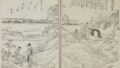
Edo Meisho Zue, a guide to famous places in Edo, includes a picture of Kaianji Temple in Shinagawa, which was known as a place to see autumn leaves. Visitors could enjoy both the colorful trees and the view of the sea.
People saw the autumn leaves and turned the scene into poems and verses.
In this sense, words could also be a way of bringing autumn home.
There is even academic research on the relationship between autumn leaves and haiku, showing how closely the seasonal scenery was connected with Japanese poetry.
In the Meiji Period, People Could Bring Home a Picture of the Landscape
In the Meiji period (1868–1912), new ways of preserving the experience of autumn became available.
Photography and picture postcards were among them.
Japan already had a long tradition of reproducing words and pictures through woodblock printing. During the Meiji period, Western-style printing technologies were introduced, and printed materials became even more widely available.
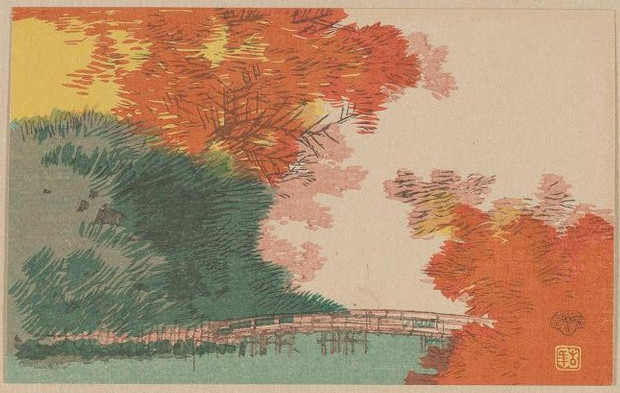
Photography also became more common, and picture postcards showing famous places began to circulate.
By the late Meiji period, postcards featuring famous places in Tokyo were being produced. Today, we can still see some of these old postcards and photograph albums.
The Tokyo Metropolitan Library’s digital archive also provides access to many postcards and photograph albums published from the Meiji period through the early Showa period.
People did not have to take the autumn leaves themselves.
They could bring home a picture of the landscape they had seen.
What Do We Bring Home Today?
And now?
When we see beautiful autumn leaves, we take out our smartphones.
We take a picture.
We save it in our photo library.
Sometimes, we post it on social media.
Just as people once brought home leaves and nuts, we now bring autumn leaves home as photographs.
And today, we do not have to keep the memory only for ourselves.
We can show our family and friends, “Look at these autumn leaves I saw this year,” or share them with people we have never met through social media.
The way we bring autumn home has certainly changed.
And Yet, We Still Enjoy Autumn Leaves
We pick up a leaf.
We turn it into a poem.
We take a photograph.
We save it on our smartphone.
The ways we “bring home” autumn leaves have changed with the times.
But people still go out looking for autumn colors.
Once a year, the trees change color.
And when that season arrives, we still think, “Let’s go see the autumn leaves this year.”
Even if photographs from last year are still sitting in our phones, we want to take new ones.
The same trees may look a little different each year, depending on the weather and who we are with.
The Japanese expression momiji-gari carries with it this long tradition of enjoying autumn.
Go out to look for autumn leaves, and bring something home.
The way we do it has changed, but the pleasure of seeking out the beauty of autumn is still with us today.
References
- Kamo no Chomei, Hojoki. The passage beginning “On the way home, I would hunt for cherry blossoms, seek autumn leaves, pick bracken, and gather nuts” was consulted.
- Arita Seisho et al., “Momiji to Haiku” (Autumn Leaves and Haiku), Bungei Ronso, No. 19, The Association of Literary Studies, Otani University, 1982, pp. 36–43.
- Saito Nagaaki et al., eds., Edo Meisho Zue (Illustrations of Famous Places in Edo), published 1834–1836. Materials from the National Archives of Japan’s “Edo no Hana Dayori” were consulted.
- Tokyo Metropolitan Library, “TOKYO Archive” — postcards and photograph albums from the Meiji period through the early Showa period.