Today, Shichi-Go-San is a familiar autumn tradition in Japan. Children dress up in beautiful clothes, visit a shrine with their families, and receive long sticks of chitose-ame, or “thousand-year candy.”
But this was not always what Shichi-Go-San looked like.
So, what was a Shichi-Go-San celebration like for children in the Meiji era?
Shichi-Go-San Originally Meant Three Separate Ceremonies
The origins of Shichi-Go-San can be traced to three traditional ceremonies for children.
At around the age of three, children celebrated kamioki, a ceremony marking the transition from having their hair kept short to growing it out.
At five, boys traditionally celebrated hakamagi, when they first wore the formal trousers known as hakama.
At seven, girls celebrated obitoki, marking the transition from children’s clothing with simple ties to wearing a kimono with an obi.
These ceremonies originally belonged mainly to the court and aristocracy. During the Edo period, they gradually spread among samurai families and wealthy townspeople.
By the Meiji era, particularly in Tokyo, these celebrations were increasingly brought together under the name “Shichi-Go-San.” Dressing children in their finest clothes, visiting a shrine, and buying chitose-ame became part of the celebration in a form much closer to what we recognize today.
What Did Children Wear in the Meiji Era?
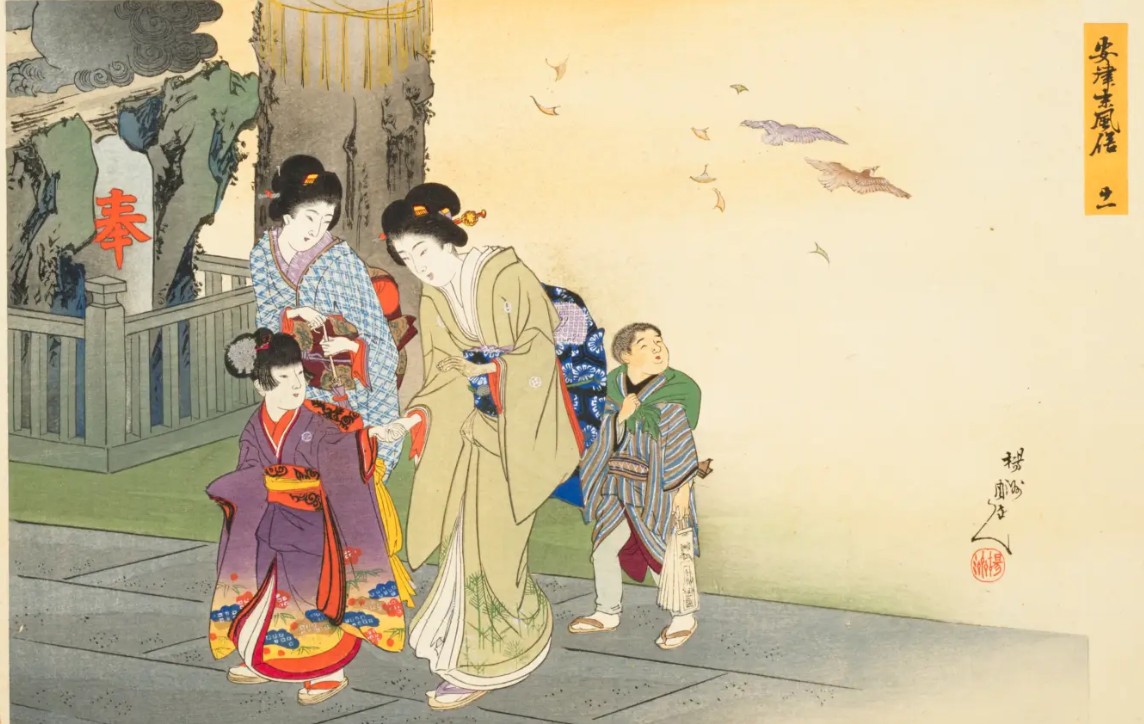
Historical photographs and ukiyo-e prints give us glimpses of how children dressed for these special occasions.
Boys might wear formal haori and hakama, while girls wore carefully arranged kimono with special hairstyles and obi.
These were not everyday clothes. A Shichi-Go-San visit was a special family occasion, and children were dressed accordingly.
The family itself might also dress up for the occasion. Looking at photographs from the period, it is easy to imagine that a Shichi-Go-San visit was not simply a religious ceremony, but also an important day to mark a child’s growth and preserve the memory of it.
When Did Chitose-Ame Become Part of Shichi-Go-San?
One of the most recognizable symbols of Shichi-Go-San today is chitose-ame, the long, thin candy traditionally given to children.
The name means “thousand-year candy,” expressing a wish for a child’s long life and healthy growth.
There are several theories about its origins. One tradition traces a form of the candy called sen’nen-ame (“thousand-year candy”) to an Edo-period candy seller named Shichibei in Asakusa during the Genroku or Hōei era (1688–1711). The candy was sold in auspicious packaging decorated with symbols such as the characters for longevity, cranes, and turtles.
Edo-period ukiyo-e also show children dressed for ceremonies and carrying long sticks of candy.
By the Meiji period, chitose-ame had become closely associated with children’s shrine visits in Tokyo.
And honestly, there is one thing about chitose-ame that may not have changed much at all: the difficulty of actually eating it.
My mother used to complain that the long, sticky candy got all over her kimono. It was so long that children could not finish it easily, either.
For a child, perhaps the candy itself was just as memorable as the ceremony.
A Shichi-Go-San Tradition That Continued to Change
The Shichi-Go-San we know today was not simply passed down unchanged from ancient times.
The three ceremonies had different origins, and the way they were celebrated varied by period and region. The custom of bringing them together as “Shichi-Go-San” became established in Meiji-era Tokyo, while the practice later spread much more widely throughout Japan.
Even so, some familiar elements were already there: dressing children in special clothes, visiting a shrine, carrying chitose-ame, and celebrating a child’s growth with family.
The clothes, photographs, and customs may have changed over time, but the occasion remained a way to mark an important moment in childhood.
And the old images leave us with something particularly precious: a glimpse of how children and families celebrated these milestones more than a century ago.
References
- National Diet Library, “Shichi-Go-San,” Kaleidoscope of Books, No. 31: Ceremonies of Coming of Age—from Ancient Times to the Early Modern Period.
An overview of the formation of Shichi-Go-San, its spread in Meiji-era Tokyo, and the origins of chitose-ame. - Taguchi Yūko, “A Study of Shichi-Go-San in the Meiji and Taishō Periods,” Josei to Keiken, No. 41, 2016, pp. 95–104.
- Taguchi Yūko, “A Study of Kamioki, Hakamagi, and Obitoki from the Edo Period Onward: Considering the Formation of Shichi-Go-San,” Girei Bunka, No. 6, 2018, pp. 124–146.