When I was a child, I used to envy a friend who wore a beautiful velvet dress. But she envied my dress, too. The front of my dress was decorated with ribbons woven through it like laces.
We did not say anything special about our clothes. We simply thought each other’s dresses were lovely.
Children have always admired things their friends own. Totto-chan: The Little Girl at the Window also includes an episode about a beautiful ribbon. But this story takes an unexpected turn.
A Ribbon to Admire
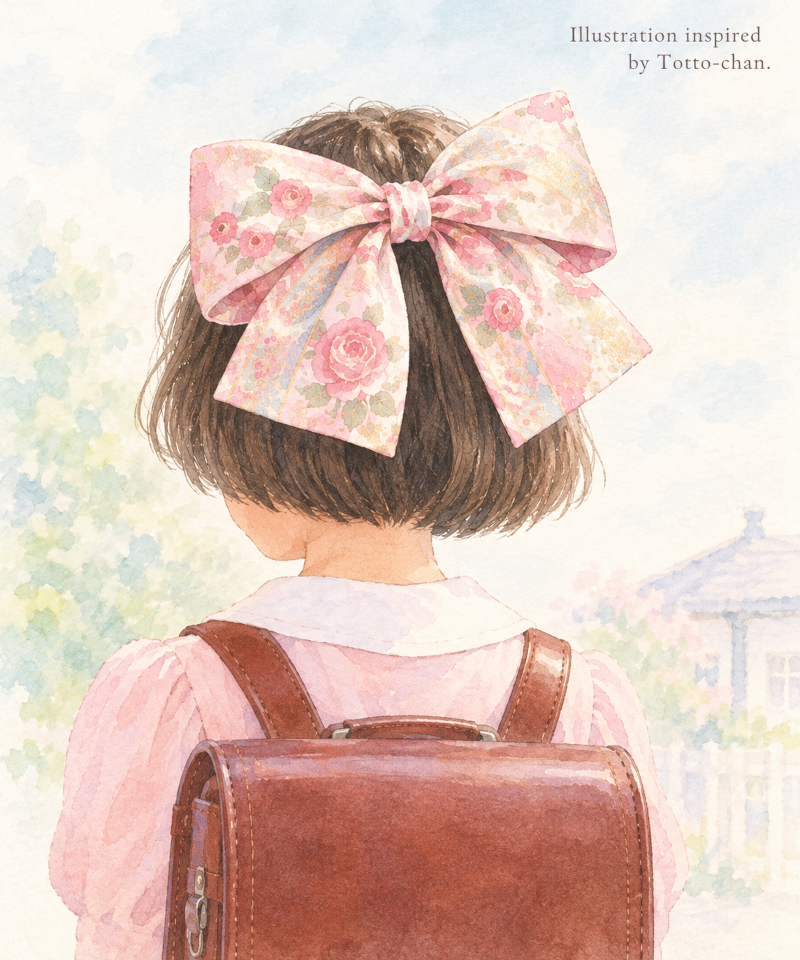
Totto-chan’s ribbon was no ordinary hair accessory. It was made of silk, with roses and various patterns woven into the fabric. It was wide and had a crisp texture, much like taffeta.
The ribbon caught the eye of Totto-chan’s friend Miyo, who was also the headmaster’s daughter. Miyo wanted a ribbon just like Totto-chan’s. Totto-chan was told not to wear her ribbon to school, but she simply replied, “Okay.”
This scene offers a memorable glimpse of childhood. One girl admires her friend’s ribbon, while the other readily accepts a request that an adult might consider unfair. Children’s feelings may be simple, but the situations that arise from them are not always so straightforward.
Ribbons and Fashion Among Schoolgirls
In Japan, ribbons were fashionable accessories that added charm to the appearance of girls and young women. When Totto-chan’s aunt was a schoolgirl, it was fashionable to wear a large ribbon at the back of the waist, over a hakama skirt.
These ribbons were imported from overseas. They were available when her aunt was a schoolgirl, but by around 1940, as Japan’s wartime period intensified, they seem to have become much harder to obtain. As the times changed, the fashions of the previous generation gradually became more distant.
There is an interesting contrast here. Ribbons were objects of admiration for girls, but whether they could obtain them depended on circumstances beyond their control. Overseas trade and shortages of goods during wartime affected even small fashion accessories.
Children may have simple reasons for admiring their friends’ clothes. Yet, when we trace the ribbons they wore, we can catch a glimpse of everyday life in that era. What was fashionable? What could people buy? And what became harder to obtain as the times changed? Even a small ribbon can offer a clue to understanding the society of the time.
Reference
・Kuroyanagi, Tetsuko. Madogiwa no Totto-chan. Illustrated by Chihiro Iwasaki. Kodansha, 1991. (Aoitori Bunko).
・National Diet Library. “奢侈品等製造販売制限規則” (Regulations Restricting the Manufacture and Sale of Luxury Goods), July 6, 1940. Nihon Hōrei Sakuin (Index of Japanese Laws).