How Ideas About Growing Up Changed in the Meiji and Taisho Eras
“Children should have time to be children.”
Today, this idea feels almost obvious.
Children study, play, and slowly grow into adults.
But in Japan at the beginning of the Meiji era, not every child had the chance to spend childhood this way.
The NHK television drama Oshin, which was broadcast in 1983, tells the story of a girl who lived during this period.
Oshin was born in 1900, the 33rd year of the Meiji era, into a poor farming family. At the age of seven by the traditional Japanese age system, she was sent away to work as a live-in childcare helper because her family needed money. She could not go to elementary school.
While carrying a baby and working, Oshin saw children going to school. She wished that she could go to school too.
Today, we naturally think that a seven-year-old child should be in school.
But this was not true for every child in Japan at that time.
So when did Japanese people begin to see “children” in a way closer to how we think of them today?
Children Existed in Pre-Modern Japan, Too
First, it is important to remember that children in Japan were not suddenly “created” in the Meiji era.
Children certainly existed before the Meiji era, and this does not mean that they were not valued.
There were also traditions that celebrated children as they grew.
One well-known example is Shichi-Go-San, a traditional celebration that continues today.
At the ages of three, five, and seven, children were celebrated for growing safely and reaching important stages of childhood.
This shows that children’s growth had a special meaning in Japanese culture.
In the past, people in Japan also commonly used kazoedoshi, a traditional age-counting system, instead of the modern age system.
A baby was considered one year old at birth, and everyone became one year older at New Year.
Because of this system, people had a somewhat different sense of age from the one we have today.
In other words, it would not be accurate to say:
“There was no childhood in pre-modern Japan.”
Children existed, and there were traditions that celebrated their growth.
So what changed?
What Was Between “Child” and “Adult”?
In the past, children were often part of everyday family life and helped with work at home.
As they grew older, they gradually took on more responsibilities.
A child in a merchant family might learn to help in the shop. A child in a farming family might help with farm work.
Some children were sent away to work as servants when they reached a certain age.
Children were therefore not simply people who did nothing until they became adults.
They learned through everyday life, took on responsibilities, and gradually moved toward becoming independent adults.
In this kind of society, age was not the only important measure.
What mattered was also:
“What can you do now?”
This way of thinking began to change during the Meiji era.
How Schools Created “Time to Be a Child”
Why did the Meiji government try to expand schools throughout Japan?
After the Meiji Restoration, Japan was trying to build a modern nation and catch up with Western countries.
One important idea behind this effort was “Fukoku Kyohei,” or “Rich Country, Strong Army.”
Japan wanted to become economically stronger and build a modern military.
To do this, the country needed people with the knowledge and skills required for modern industry and society.
Education therefore became increasingly important.
In 1872, the Meiji government issued the Gakusei, or Education System Order, creating a framework for establishing schools throughout Japan.
Of course, this did not mean that every child immediately began attending school.
Children’s lives still differed depending on their families, communities, and economic circumstances.
Even so, a major change had begun.
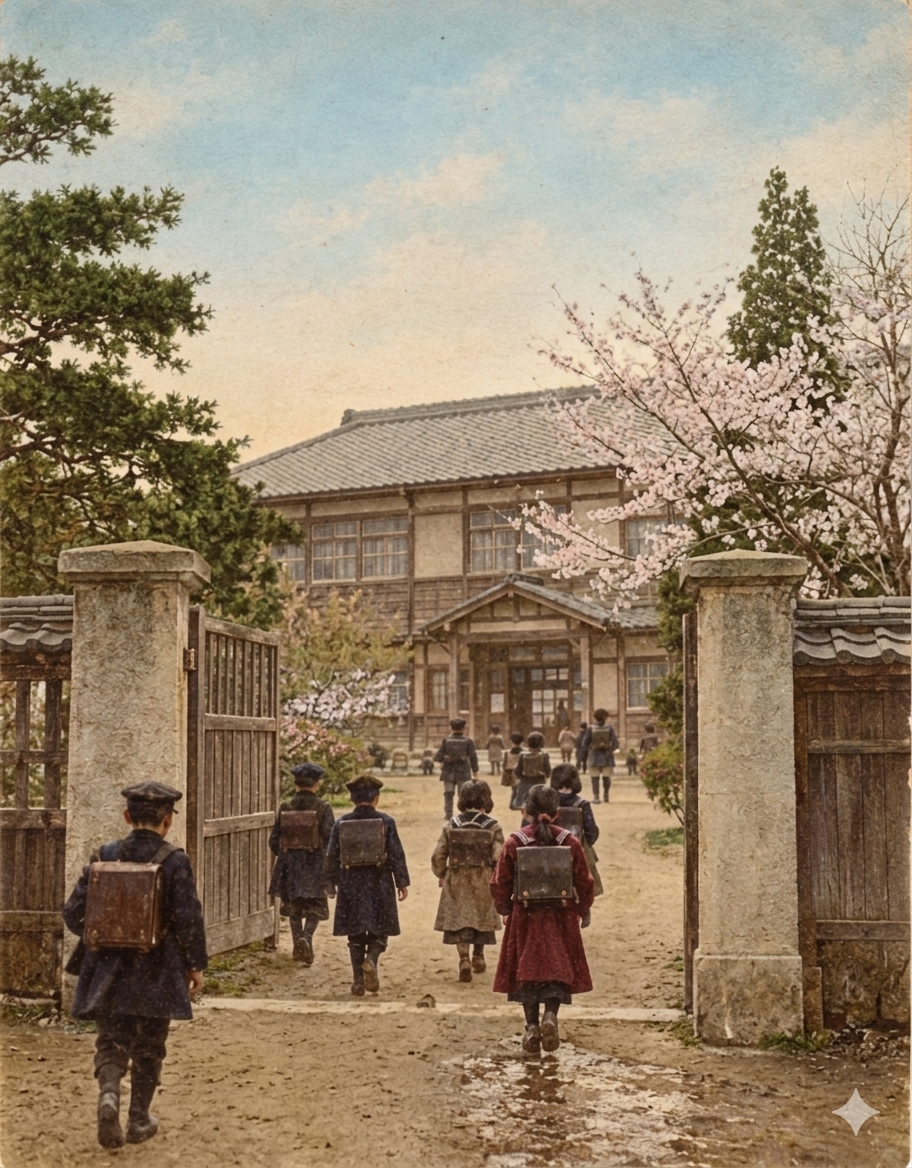
At school, children of similar ages gathered together and studied according to a fixed timetable.
There were grades, promotion, and graduation.
Alongside the knowledge and skills children learned at home and in their communities, a new kind of time became part of society:
“Time to study at school before becoming an adult.”
The school system was not created simply to give children a protected childhood.
It was part of a much larger project: building a modern nation.
But as the system spread, it also changed how people in Japan thought about children and growing up.
Children came to be seen not only as young members of a family who could help with work, but also as:
“people who grow through education.”
When Growing Up Became a Special Period of Life
As more children spent longer periods in school, another stage between childhood and adulthood became more clearly visible.
This was the period of the young person, or seinen.
Students at middle schools, high schools, vocational schools, and universities were no longer small children.
Male students and female students were entering a new stage of life.
They were not yet fully independent adults working in society either.
They studied, spent time with friends, read books, and thought about their futures.
This period of “becoming an adult” gradually came to have a special meaning.
The words seinen (youth) and seishun (youthful years or “springtime of life”) also developed the special meanings they have today during the modern period.
The Idea That Childhood Was Special
From the late Meiji era into the Taisho era, another new way of thinking about children began to spread.
It was the idea that:
“Children have something special simply because they are children.”
In 1918, the seventh year of the Taisho era, writer Suzuki Miekichi founded the children’s magazine Akai Tori (“The Red Bird”).
Through the stories and songs published around Akai Tori, the idea of dōshin, or the “child’s heart,” became important.
Children were not simply small, unfinished adults.
They were seen as having a purity and sensitivity that adults might lose as they grew older.
This way of valuing “childlike” qualities became stronger from the late Meiji era into the Taisho era.
Childhood itself was beginning to be seen as a special and meaningful period of life.
Yet Children Like Oshin Still Existed
However, the spread of this new idea about childhood did not mean that every child could go to school, play, and take their time growing up.
Children’s lives were very different depending on their family’s economic situation.
Some children went to school, while others helped their families or were sent away to work.
This is why the story of Oshin is so memorable.
In the Meiji era, the same society included both:
“children who went to school” and “children who worked.”
The modern idea of childhood did not suddenly transform the lives of every child.
First, a new way of thinking about children began to develop in society. Little by little, it also became part of everyday life.
Conclusion
“Childhood” was not born on a single day.
People in pre-modern Japan already had traditions that saw children as growing members of society. Then the Meiji school system created a new kind of time for children, while new ideas about childhood, such as dōshin, spread from the late Meiji era into the Taisho era.
Little by little, the stages from childhood to youth and then adulthood came to be understood in ways that are closer to our own ideas today.
So what was everyday life actually like for children in the Meiji and Taisho eras?
What did they study at school? How did they play? What words did they use? And what did they dream about?
On this blog, I will explore what childhood and youth were like in Meiji and Taisho Japan, using historical sources to introduce the everyday lives of the people who lived through these changing times.
References
- Kawahara, Kazue. Kodomo-kan no Kindai: “Akai Tori” to “Dōshin” no Riso [Modern Views of Children: Akai Tori and the Ideal of “The Child’s Heart”]. Chūō Kōron Shinsha, 1998.
- Wasaki, Kōtarō. Meiji no “Seinen”: Risshi, Shūyō, Hanmon [Youth in the Meiji Era: Ambition, Self-Cultivation, and Inner Struggles]. Minerva Shobo, 2015.
- Kimura, Naoe. Seinen no Tanjō: Meiji Nihon ni okeru Seijiteki Jissen no Tenkō [The Birth of Youth: The Transformation of Political Practice in Meiji Japan]. Shinyosha, 1998.
- Wasaki, Kōtarō. “Kindai Nihon ni okeru ‘Seinenki’ Gainen no Seiritsu: ‘Risshi no Seinen’ kara ‘Gakusei Seinen’ e.” Ningen・Kankyōgaku, Vol. 19, 2010.
- Ishikawa, Matsutarō. Hankō, Shijuku, Terakoya: Kinsei Nihon no Kyōiku Isan [Domain Schools, Private Academies, and Temple Schools: Japan’s Educational Heritage in the Early Modern Period]. Shogakukan, 1990.
- Amano, Ikuo. Kyōiku to Senbatsu no Shakaishi [A Social History of Education and Selection]. Chikuma Gakugei Bunko, 2006.