A form of entertainment that people loved from the Edo period to the early Showa era
Introduction
Before TV, movies, and smartphones, how did people in Japan enjoy stories?
One answer is nozoki karakuri, or the “peep box.”
You looked through a hole in a wooden box, and colorful scenes appeared one after another. It was a strange, nostalgic kind of entertainment. From the Edo period to the early Showa era, it charmed ordinary people for a very long time. In this article, I’d like to introduce its world.
When I was about ten years old, I stood in the dark at a shrine festival one evening. I was eating a candy apple and holding someone’s hand. It might have been my mother’s, or a friend’s. I can’t remember which. In front of us, a man standing next to some kind of device was telling a story to the crowd. The sound from an old cassette recorder was distorted, and that made it even scarier.
To this day, I’m not sure what I was watching. It might have been a kamishibai show, or something close to a peep box. But I still remember the feeling of being pulled into a story in the half-dark. People in the Meiji and Taisho eras may have felt something similar when they gathered around a nozoki karakuri at a festival.
What Is Nozoki Karakuri?
A nozoki karakuri is a show where you look through a lens in a box or a small stall and enjoy the pictures inside. The pictures were painted in strong perspective. Through the lens, they looked big and deep.
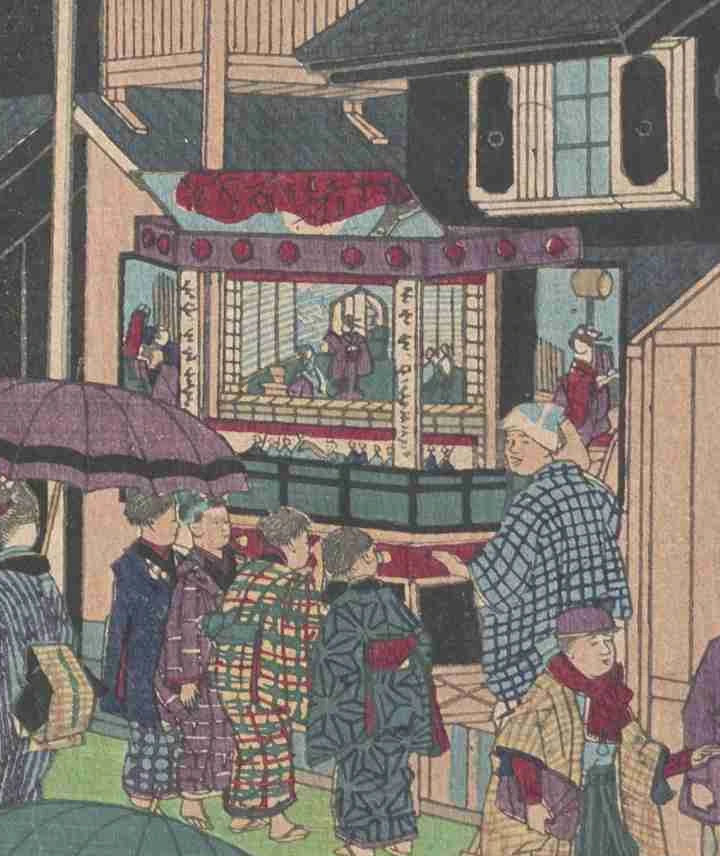
A large stall was described in Meiji Shobai Ōrai by Sadanosuke Nakada. It was a wheeled cart about two meters by one meter, with a frame around it. On the front, there were five or six round holes with convex glass lenses. Pictures hung inside, and they were switched one after another as the story went on. The stall was also decorated with colorful pictures of the characters and scenes. These decorations worked as signboards to attract visitors.
Early versions were much smaller. In the middle of the Edo period, candy sellers carried them around to attract customers.
History and Origins
People say that nozoki karakuri came from the West through Nagasaki. But its exact origin is not clear. It already appears in records from the middle of the Edo period. It was most popular from the end of the Edo period through the Meiji era.
A small “peep glass” for one person was a pleasure for wealthy families, such as feudal lords. Ordinary people, on the other hand, enjoyed nozoki karakuri shows at festivals and temple grounds for a long time. The stalls were made by skilled craftsmen, including some in Himeji, Hyogo Prefecture. Street vendors took them around to many places.
Even after movies and TV became popular, nozoki karakuri did not disappear right away. Many lasted until the early Showa era. Some continued until around the war years.
What Kinds of Stories Did People See?
The stories were very varied. They included historical dramas, legends, ghost stories, and scenes from foreign countries.
- Chushingura (the story of the 47 loyal samurai)
- Love stories such as that of Oshichi, the greengrocer’s daughter
- Historical tales such as the Genpei War
- Ghost and monster stories
- Foreign cities, animals, and inventions
Surprise, laughter, fear, and tears: scenes that moved people’s hearts appeared one after another, and the audience was drawn into the story.
Why It Mattered to Culture
Nozoki karakuri was more than a simple show. You can see how familiar it was from the titles of old books. Many books have titles like “○○ Nozoki Karakuri.” The name was used as a metaphor in book titles to introduce many different subjects. This shows that nozoki karakuri was a very familiar part of daily life.
Many of the stories were already well known from joruri puppet theater and kabuki. The audience experienced familiar stories again, through enlarged pictures and the voice of the storyteller. The stalls were also carefully made. The colorful pictures of characters on both sides worked as signboards to attract people. Pictures, storytelling, and the act of “peeking” all came together. It was a small, mobile theater.
Where You Can See It Today
Real nozoki karakuri are very rare today. But you can see them at the Maki Local History Museum in Niigata City. The stories shown there are “The Ghost and the Bullied Stepchild” and “Oshichi, the Greengrocer’s Daughter.”
The Mihara City History and Folklore Museum owns a rare nozoki karakuri dating from the late Taisho period. It is now on display at the Kui Museum of History and Folklore in Mihara City. The performance features the story of Shuntokumaru.
The museum also introduces the history and mechanism of nozoki karakuri through its exhibits and videos.
Please check each museum’s official website for opening hours and visitor information before your visit.
The Edo-Tokyo Museum’s digital archive also has photos and information about nozoki karakuri in its collection.
Conclusion
A nozoki karakuri looks like a simple wooden box. But inside, it holds stories, technology, culture, and the curiosity of the people of that time.
For those of us who swipe screens today, the journey of the imagination that begins with “peeking” may feel both nostalgic and new.
Japan had many other forms of visual entertainment before the arrival of cinema. Explore more in our guide to Visual Culture in Japan Before Cinema.
References
- Nakada, Sadanosuke. Meiji Shobai Ōrai [Merchants and Trades of the Meiji Era]. Tokyo: Seiabō, 1969.
- Kami, Shōichirō. Jidō Bunka Shosho Yūyū [Wandering Through Books on Children’s Culture]. Tokyo: Shuppan News Sha, 1988.
- Itagaki, Shunichi. “Nozoki Karakuri ‘Yūrei no Mamako Ijime’ no Seisaku Nendai to Seisakuchi” [The Date and Place of Production of the Nozoki Karakuri “The Ghost and the Bullied Stepchild”]. Niigata no Seikatsu Bunka [Everyday Life and Culture of Niigata], no. 22 (2016): 1–5.
- Sakai, Mika. “Kinsei Nozoki Karakuri wa Nani o Miseta ka, Sono 1: Karakuri o Nozoku” [What Did Early Modern Peep Boxes Show? Part 1: Looking into the Karakuri]. Nenpō Hi-moji Shiryō Kenkyū [Annual Report of Research on Non-Written Materials], no. 8 (2012): 107–136.
- Maki Local History Museum, Niigata City; Kui Museum of History and Folklore, Mihara City
- Edo-Tokyo Museum Digital Archives