In old Japan, people did not always look only to the body for the cause of a cold.
Some people believed that a “god of colds” or a god of illness could bring sickness. They had customs for driving these beings away from their homes and communities.
I explain more about how people in old Japan cared for themselves when they were sick, and how they understood illness, in my article “What Did People in Old Japan Do When They Got Sick?”
But one of the most interesting practices was called Kazegami-okuri, or “sending away the god of colds.”
The god of colds was sent out of the home and the community.
And one place was especially important as its final destination:
the village boundary.
Why did people send the god of colds all the way to the village boundary instead of simply outside the house?
Where Did the God of Colds Come From?
People in old Japan sometimes connected illness with invisible beings.
Colds were one example.
They imagined beings such as a “god of colds” or a god of illness, and tried to drive them out of the places where they lived.
This was the idea behind Kazegami-okuri.
It was not simply a ritual performed inside the home.
The god was taken outside, through the community, and finally to its boundary.
In a way, it was like taking the god of colds on a small journey out of the village.
Sending the God of Colds Outside the Village
In the Ina Valley of southern Nagano Prefecture, customs known as Kotono-kami-okuri and Kazegami-okuri have been recorded.
According to Hiroto Sakurai of the Iida City Museum, writing for the Agency for Cultural Affairs, these events took place around February 8 and 9 and involved sending away gods of illness, including those believed to cause colds.
Each household prepared a bamboo branch.
Small pieces of paper holding things such as family members’ nail clippings, hair, and washed rice were attached to it.
A paper strip with words such as “Sending Away the God of Illness” or “Sending Away the God of Colds” was also hung from the bamboo.
The bamboo was then used to cleanse the house.
This was where the journey began.
People carried the bamboo through the community, walking together while singing to the sound of bells and drums.
They then took it to the edge of the community.
One chant was:
“Send away the god of colds! How far should we send it?”
Finally, the god was sent away at the village boundary.
In some areas, the god was passed from one community to another, with the final destination being the boundary with a neighboring village.
The ritual began inside the home, continued through the community, and ended outside the village.
The god of colds was literally carried outside the place where people lived.
“Drive Out the God of Colds!” — Children Send It Away
The city of Matsumoto also has traditions known as Kazegami-okuri, or sending away the god of colds.
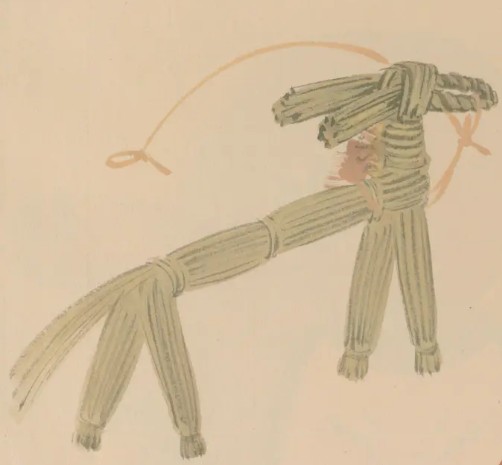
In Narao, a village in Matsumoto, people traditionally made straw horses and other figures on February 8.
Children pulled the straw horse through the village on a rope.
As they walked, they shouted:
“Drive out the god of poverty! Drive out the god of colds!”
The straw horse was burned along the way. Finally, it was burned at the boundary with a neighboring community, together with words meant to drive away the god of illness.
This tradition is recorded today as an Important Intangible Folk Cultural Property of Matsumoto City.
In another area, people made a straw object shaped like a centipede, representing the god of illness.
Children and adults pulled it to the edge of the community, where it was left behind.
According to Matsumoto City, the centipede represented a god of illness.
Here again, we can see the idea of moving illness outside the area where people lived.
And You Must Not Look Back
There is another fascinating rule connected with these rituals.
After sending the god away, people were not supposed to look back.
In one Matsumoto tradition, after sending away the god of colds, the children say:
“You mustn’t look back.”
The idea was that the god of illness might follow them home.
When you think about it, the actions are very clear.
Drive away the illness.
Take it to the village boundary.
Leave it there.
Then return without looking back.
The wish that “it must not come back here” can be seen in each step of the ritual.
Why Was the Final Destination the Village Boundary?
So why did people take the god of colds all the way to the village boundary instead of simply taking it outside the house?
The Agency for Cultural Affairs records the Matsumoto Koto-yoka tradition as a ritual in which straw horses, centipedes, and other objects were taken to the village boundary to drive away gods of illness.
In other words, the village boundary was used as a place to send the god of illness beyond the community.
Inside and outside the home.
Inside and outside the community.
The place where people lived and the world beyond it.
The village boundary marked the line between the community and the outside.
This kind of boundary was used as a place for sending gods of illness out of the village.
In Kazegami-okuri, the goal was not simply to “cure” an illness.
The people moved the being believed to cause the illness out of the place where they lived.
And they did this by walking all the way to the boundary.
A Cold Was Something You Could “Drive Away”
Today, we explain colds as infectious illnesses caused by viruses and other factors.
But in old Japan, people could also imagine that a being brought the illness and that it could be driven away.
That is why they might:
Cleanse the house,
send away the god of colds,
walk through the village,
go all the way to the boundary,
and leave the god there.
The goal was not only to drive illness out of the body.
It was also to drive it out of the place where people lived.
The expression “drive away a cold” carries traces of this older way of thinking about illness.
And the final destination for the god of colds was the boundary between the inside and outside of the community.
From the home to the village.
From the village to the boundary.
And beyond it.
The ritual of sending away the god of colds offers a quiet glimpse into how people in old Japan understood the relationship between illness, everyday life, and the boundaries of their community.
Reference
- Hiroto Sakurai, “Kotoyoka Customs in the Ina Valley,” Bunkaru, Agency for Cultural Affairs, 2016.
- Matsumoto City, “Narao’s Ritual of Sending Away the God of Poverty and the God of Colds.”
- Matsumoto City, “Nakamura’s Ritual of Sending Away the God of Colds.”
- Agency for Cultural Affairs, “Matsumoto Koto-yoka Ritual,” National Cultural Heritage Database.
- Hachijuni Cultural Foundation, “Matsumoto Koto-yoka Ritual,” Traditional Culture of Shinshu.