When someone in a family became sick, family members usually took care of them.
But what happened when the whole family became sick?
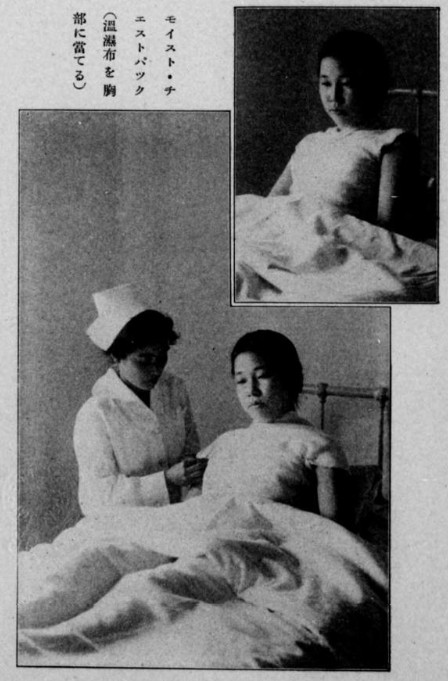
In Taisho-era Japan, there were nurses who went to patients’ homes to provide care. They were known as hōshutsu kango-fu, or visiting nurses.
Instead of working only in hospitals, these nurses could be sent to a family home when their help was needed.
We can get a glimpse of this system from the writings of the writer Uchida Hyakken.
When the Whole Family Became Sick During the Spanish Flu
The Spanish flu spread widely in Japan from 1918 to 1919.
In his essay Hōkyū (“Salary”), Uchida Hyakken wrote about his experience during the epidemic.
Members of his family became sick one after another, until eventually everyone in the family was ill.
There was no one left who could take care of the others.
So they hired a nurse.
The nurse’s daily pay was 1 yen 50 sen.
And she was not hired for just a day or two. She stayed for nearly a month, and the total cost was more than Hyakken’s monthly allowance.
At the time, Hyakken received a monthly allowance of 40 yen.
In simple terms, hiring the nurse for about 30 days cost around 45 yen.
In other words, when the whole family became sick, simply getting someone to care for them could cost more than a month’s allowance.
How Much Was 1 Yen 50 Sen?
To understand what this amount meant at the time, we can compare it with the price of a bowl of soba.
According to The History of Prices in the Meiji, Taisho, and Showa Eras, a bowl of soba cost 5–6 sen in 1918, the year the Spanish flu began to spread in Japan.
So 1 yen 50 sen was roughly the price of 25 to 30 bowls of soba.
Of course, the price of a bowl of soba and the pay for a nurse cannot be directly compared.
Still, putting the two numbers side by side gives us a sense of how large 1 yen 50 sen could have seemed to people at the time.
And in Hyakken’s case, the cost of hiring a nurse for nearly a month exceeded his monthly allowance.
Illness could affect not only the body, but also the household budget.
Nurses Came to People’s Homes
So where did the nurse hired by Hyakken come from?
During the Taisho era, there were organizations known as hōshutsu kango-fu kai, or visiting nurses’ associations.
Families and hospitals could request a nurse, and the association would send one to provide care.
Visiting nursing was not a small part of nursing in Japan at that time. Research on the history of nursing shows that, by the end of the Taisho era, visiting nurses were a major part of the nursing profession. In 1923, about 60% of nurses were affiliated with visiting nurses’ associations.
In other words, for people living in Taisho-era Japan, there was another option:
Instead of taking the patient to a hospital, they could have a nurse come to their home.
In 1917, the nurse and educator Ozeki Nagi published Hōshutsu Kango-fu Kokoroe (“Advice for Visiting Nurses”).
The book explained the attitude and behavior expected of nurses working in patients’ homes. A sixth edition was published in 1919, showing that this type of nursing continued to be practiced.
Nursing Was Also a Job
For Uchida Hyakken, 1 yen 50 sen was a large expense.
But for the nurse, it was payment for her work.
For a sick family, it was:
money they paid to have someone care for their family member.
For the nurse, it was:
income earned through her work.
During the Taisho era, women could work as nurses not only in hospitals, but also by going to patients’ homes.
Taking care of sick people was not only a family’s responsibility.
It had also become a profession.
Who Took Care of the Sick?
When we think about how people dealt with illness in the past, it is easy to focus only on medicine and doctors.
But there were other questions, too.
Who would take care of the sick?
If the family could not do it, who could they ask for help?
And how would they pay for it?
Uchida Hyakken’s account of the Spanish flu gives us a glimpse of the burden that illness could place on a household, down to the actual cost of hiring a nurse.
Illness was not only a matter of the body.
It could also affect the time and labor of caregivers—and the household budget.
References
- Uchida Hyakken, Hōkyū (“Salary”)
- The History of Prices in the Meiji, Taisho, and Showa Eras
- Watanabe Kimiko, “Personal Histories of Visiting Nursing,” Kango Kyoiku, Vol. 23, No. 5, 1982 The History of Visiting Nurses’ Associations, 2025
- Ozeki Nagi, Hōshutsu Kango-fu Kokoroe, 1917
- Kimiko Watanabe, “Personal Histories of Visiting Nursing,” Kango Kyoiku, Vol. 23, No. 5, 1982, pp. 329–335
- The History of Visiting Nurses’ Associations, Kango no Kagaku Sha, 2025