When reading Demon Slayer: Kimetsu no Yaiba, you may notice that the characters sometimes talk about their physical condition using surprisingly specific numbers.
One example appears when Muichiro Tokito explains the conditions for developing the Demon Slayer Mark.
In Chapter 129, “The Mark,” Muichiro says that when his mark appeared, his body temperature was over 39°C (102.2°F) and his heart rate was over 200 beats per minute.
For us today, a number like 39°C is familiar.
But what about Japan in the Meiji era, before the Taisho era in which Demon Slayer is set?
Did people in Japan have thermometers then?
Japan Made Mercury Thermometers in the Meiji Era
Yes, they did.
In 1883, during the Meiji era, Kosuke Kashiwagi made a mercury thermometer in Japan.
At that time, thermometers were already being used in Western medicine, but imported thermometers were expensive.
Kashiwagi worked to produce thermometers in Japan using glass and mercury.
In 1885, he also succeeded in making a thermometer with a maximum-temperature function. This allowed the highest temperature to remain visible even after the thermometer was removed from the body.
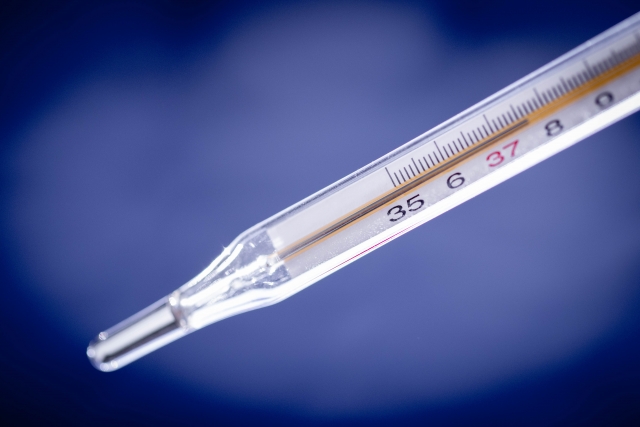
This was the same basic idea used in the mercury thermometers many of us remember from childhood.
By 1893, the Tokyo Microscopic Institute was also testing and checking thermometers, which were sometimes called ken’onki, or “temperature-measuring instruments,” at the time.
How Did Doctors Know Someone Had a Fever?
Of course, people had fevers long before thermometers existed.
Doctors could listen to patients and observe their condition. They looked at things such as the patient’s complexion, sweat, skin temperature, pulse, and breathing.
They could also examine the tongue and inside of the mouth.
In other words, doctors used many different signs from the body to understand what was happening.
Then modern medicine added something new:
a number.
Instead of simply saying,
“The patient feels hot,”
a doctor could say,
“The patient’s temperature is 39°C.”
This was an important change. The condition of the human body could now be measured and recorded as a number.
What Does 39°C Mean to Muichiro?
Now let’s return to Demon Slayer.
In Chapter 129, Muichiro remembers that his temperature was over 39°C when his Demon Slayer Mark appeared.
He explains that he remembered the feeling because he had once developed a fever while being treated at the Butterfly Mansion. At that time, his temperature had been measured at 39°C, and the heat he felt when his mark appeared reminded him of that experience.
This is an interesting detail.
For Muichiro, 39°C is not just a number.
It is connected to a physical feeling he remembers from his own experience.
Demon Slayer is set in the Taisho era, but the use of thermometers to measure body temperature was already established in Japan by then.
From Mercury Thermometers to Digital Thermometers
Mercury thermometers continued to be used in Japan for many years, from the Meiji and Taisho eras through the Showa era.
They are the familiar thin glass thermometers containing a small column of silver-colored mercury.
Later, electronic thermometers appeared.
In Japan, Terumo introduced a predictive electronic thermometer for hospitals in 1983 and a model for home use in 1984.
Traditional mercury thermometers took several minutes to measure a stable temperature. Predictive electronic thermometers could estimate the final temperature from the early changes in temperature, making measurement much faster.
Terumo stopped producing mercury thermometers in 1985.
The Mercury Thermometers I Remember
I used a mercury thermometer when I was a child, too.
One day, my mother accidentally broke one.
Tiny silver drops of mercury came out of the glass tube and rolled across the floor.
My mother immediately told me:
“Don’t touch the mercury!”
Today, the manufacture and import/export of mercury-containing thermometers are regulated in Japan because of the health and environmental risks of mercury.
Looking back, the mercury thermometer from my childhood was connected to a much longer history—one that goes all the way back to the Meiji era, when Japan began producing mercury thermometers.
We think it is completely normal to take our temperature when we are sick.
But the simple act of saying “I have a fever of 39°C” is part of a much longer history of modern medicine.
A feeling of heat became a number.
References
- Koyoharu Gotouge, Demon Slayer: Kimetsu no Yaiba, Vol. 15, Chapter 129, “For Those Who Bear the Demon Slayer Mark,” Shueisha, 2018.
- Saga Prefecture Pharmaceutical Association, “Kusuri Hyakuwa” — Information on Kosuke Kashiwagi and mercury thermometers.
- Tōyama Tsubakikichi Memorial Museum, “Chronology and Achievements” — Records on thermometer testing in 1893.
- Terumo Temperature Research Institute, “History of Thermometers.”
- Terumo, TERUMO 100th HISTORY.
- Ministry of Economy, Trade and Industry (METI), “Products and Manufacturing Processes Subject to Regulation.”