From Educational Magic Lanterns to Interactive Whiteboards
Today, it is perfectly normal to use an interactive whiteboard or projector to show photographs and videos on a classroom screen.
The teacher displays an image, and the students look at the same screen.
This kind of classroom scene feels completely natural to us.
But surprisingly, more than 100 years ago, during the Meiji period, teachers were already using large projected images in darkened classrooms.
The device they used was called a magic lantern, (gentō) in Japanese.
A magic lantern used light to project images, often painted or printed on glass slides, onto a screen.
Magic lanterns were used for entertainment and lectures, but that was not all.
They were also used in education to show children images of things they could not easily see in their everyday lives.
So, what did children in the Meiji era see through magic lanterns?
“Educational Magic Lantern Show” — Children Looking at the Screen
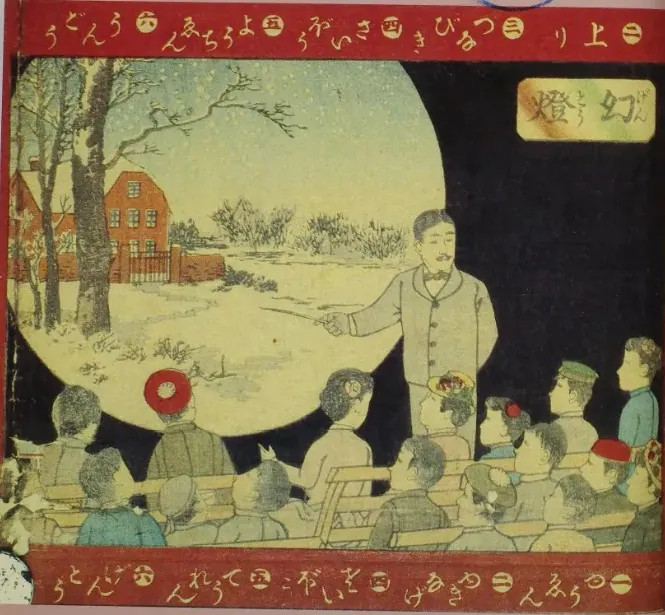
First, let’s look at an illustration titled “Educational Magic Lantern Show.”
It shows a group of children gathered together, looking at a single screen.
And projected on that screen is a lion.
The illustration gives us a glimpse of what it may have been like for children to watch an educational magic lantern show at the time.
Today, we can see lions not only at zoos, but also on television and the internet.
For children in Meiji-era Japan, however, a lion was not an animal they could easily encounter in everyday life.
Imagine seeing such a distant and unfamiliar animal suddenly appear large on a screen in a darkened room.
It must have been a memorable experience for the children.
A magic lantern could bring a distant world right before their eyes, without taking them outside the classroom.
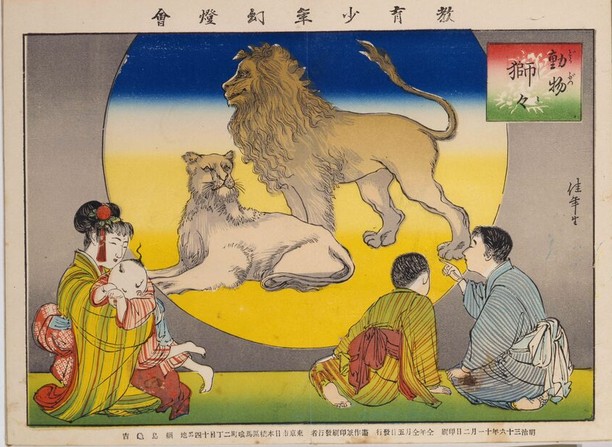
Children Gathering to See Educational Magic Lantern Slides Kanen, 1903 Source:Edo-Tokyo Museum
Magic Lanterns as Visual Teaching Tools
Magic lanterns projected images onto a screen using light.
During the Meiji period, they were used not only for entertainment but also for education and lectures.
Instead of explaining something only with words, teachers could actually show their students an image.
This made it possible to introduce children to distant landscapes, unfamiliar animals and plants, historic buildings, and many other things they might never have seen in person.
In this way, magic lanterns have something in common with the use of photographs and videos in classrooms today.
Students were not simply listening to an explanation.
They could learn by actually looking at something.
Magic lanterns were visual teaching tools that made this kind of learning possible.
Everyone Looking at the Same Screen
If we look again at the illustration Educational Magic Lantern Show, there is another interesting detail.
The boys are not looking at different things.
They are all looking at the same screen.
This is a little different from the experience of reading a textbook individually.
When a teacher projected an image, everyone in the room could look at the same thing.
The teacher could explain the image while directing the students’ attention to particular details.
In other words, a magic lantern was not simply a device for making an image larger.
It was also a way for everyone in the classroom to share the same visual experience.
When Looking Became Learning
Educational magic lantern shows used a wide variety of images as teaching materials.
Distant landscapes.
Unfamiliar animals and plants.
Historic buildings and events.
Things that were difficult to imagine from words in a textbook could be presented as images.
Magic lanterns made it possible for education to become something students could learn by looking, rather than simply by listening to the teacher.
Of course, looking at an image alone was not enough to complete a lesson.
Students listened to the teacher’s explanations and thought about what they were seeing.
The combination of explanation and visual materials could help children understand things that might otherwise have been difficult to grasp.
And We, Too, Once Learned by Light
Now let us jump forward a little in time.
About 20 years ago, overhead projectors (OHPs) were commonly used in schools and university lectures.
Teachers prepared materials and diagrams on transparent sheets and used light to project them onto a large screen.
Today, it is rare to see an OHP in a classroom.
But when we compare it with the magic lantern, an interesting similarity emerges.
The teacher prepares the material.
↓
Light is used to enlarge and project it.
↓
Everyone in the classroom looks at the same thing.
Of course, the technology and materials used for Meiji-era magic lanterns and OHPs were completely different.
Even so, the basic idea was surprisingly similar:
Project an image in the classroom, and let everyone see it together.
The OHP, which once seemed completely ordinary to us, was also a device for sharing visual information through light.
Seen this way, the magic lantern of the Meiji era may feel a little closer to us.
From Magic Lanterns to Interactive Whiteboards
And then came the present day.
After OHPs, projectors became widely used, and today many classrooms have interactive whiteboards.
Magic lantern → OHP → Projector → Interactive whiteboard
The technology has changed dramatically.
The materials being projected have also changed—from glass slides to transparent sheets, and eventually to digital images and videos.
But one basic idea remains:
Project an image in the classroom, and let everyone see it together.
Seen in this light, the magic lantern was more than just an unusual old-fashioned projection device.
It can also be seen as part of the long history of using visual materials as a way of learning in the classroom.
The “World” Projected into the Classroom
The children of the Meiji era saw lions, snowy landscapes, and many other images through magic lanterns.
For them, these may have been distant worlds they could not yet see with their own eyes.
But with a magic lantern, those worlds could travel into the classroom on a beam of light.
A single image appeared large on a screen in a darkened room.
And there, beyond that image, was a world outside the classroom.
Today, we can use projectors and interactive whiteboards to show photographs and videos from all over the world.
The machines have changed.
The images have changed.
But the sight of a classroom full of people looking together at a single screen has a much longer history than we might imagine.
“Project it, and let everyone see.”
This simple idea of visual learning has continued to evolve—from the magic lanterns of the Meiji era to OHPs, projectors, and today’s interactive whiteboards.
On this blog, you can also explore more stories about magic lanterns, including “Japan’s Visual Culture Before Cinema,” “Dreams of Meiji Women in the Magic Lantern Light,” and “Kenji Miyazawa and the Magic Lantern Shows.”
I hope you’ll take a look!
Reference
Kyōiku Jihō (Educational Bulletin), No. 419, Tokyo Metropolitan Educational Research Institute, Dec. 1982