When we get sick, we usually go to a hospital, take medicine, and get plenty of rest.
But what did people in Japan do in the past, when hospitals and modern medicine were not as easily available as they are today?
In fact, people in the past did not simply do nothing when they became sick.
Families cared for sick members, prepared special foods and drinks, and used medicines.
They also prayed for the sick person to recover and tried to keep away things that they believed could cause illness.
Over time, people also developed ways to observe and measure the body, such as checking body temperature.
Dealing with illness was not only about medicine. It was also connected to everyday life, beliefs, local customs, and ways of understanding the human body.
When Someone in the Family Became Sick
When we think about how people dealt with illness in the past, the first place we should look is the home.
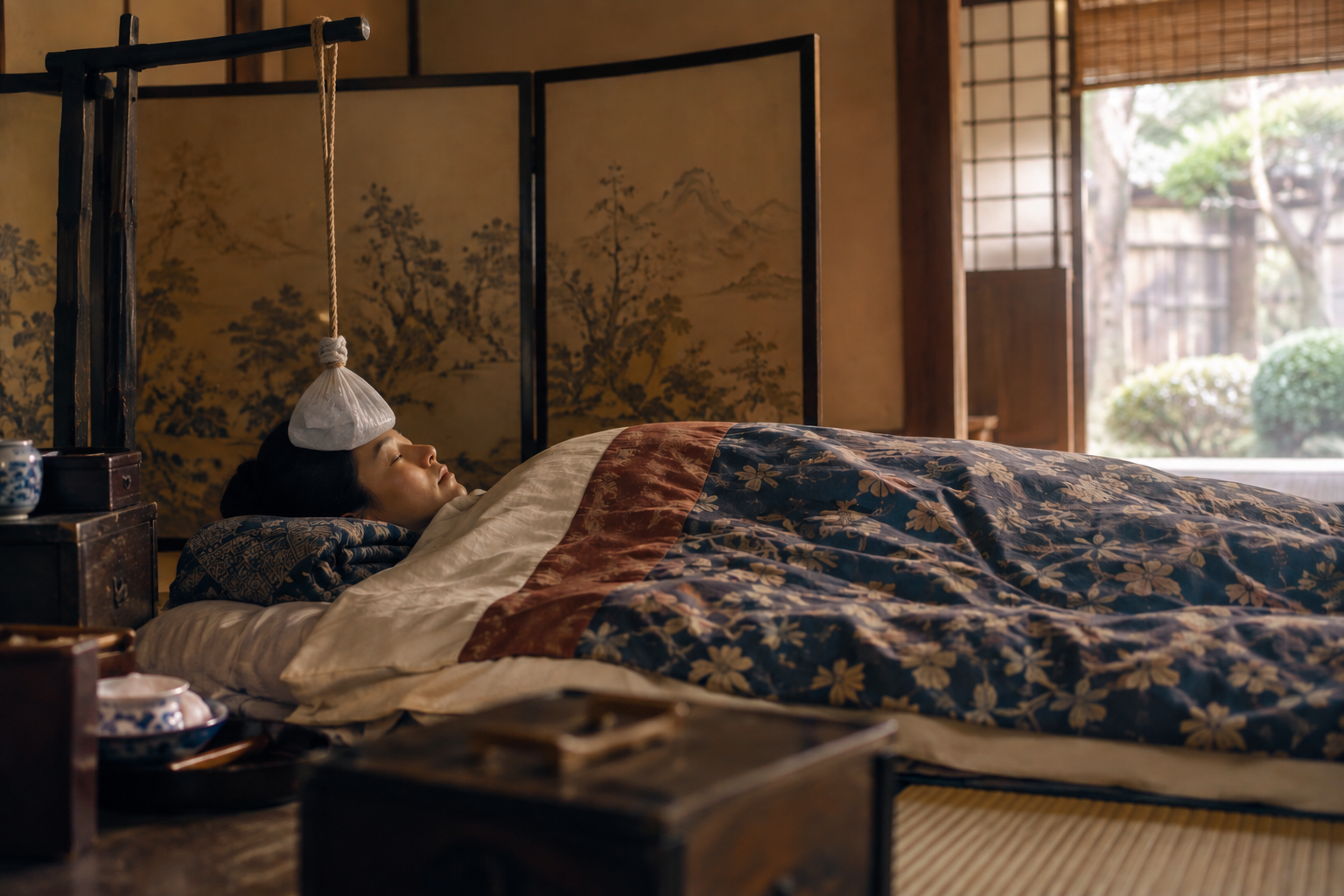
When someone in the family became sick, other family members cared for them.
They let the sick person rest.
They kept them warm.
They prepared food that was easy to eat.
They gave them something to drink.
These everyday acts of care did not require special medical knowledge. They were simple and familiar ways of dealing with illness.
Families and local communities also had their own knowledge and practices, passed down from one generation to another.
For example, tamago-zake, a warm drink made with sake and egg, was one traditional remedy for a cold.
From our modern perspective, it may look like an old-fashioned home remedy. But when we look at foods and drinks like this, we begin to see that the history of illness is also closely connected to the history of family life.
However, when an illness was serious or lasted a long time, caring for a sick family member could be difficult for the family alone.
In such cases, people could also hire a nurse to care for the sick person at home.
In other words, caring for the sick did not always take place in a hospital.
Family members provided care, while people with professional knowledge could be called upon when necessary.
When we look at how people cared for sick family members and whom they turned to for help, we can see another part of the history of illness: the history of caring for sick people at home.
Did People in the Past Know About Doctors and Medicine?
It is easy to imagine that people in the past did not know about doctors or medicine.
But of course, this was not the case.
Japan had doctors who treated illnesses from early times, and many kinds of medicines were used.
During the Edo period (1603–1868), for example, medicine sellers traveled from place to place, and medicines for home use were also available.
However, medical care was not equally available to everyone as it is today.
The medical care people could receive differed depending on where they lived, their social status, and their financial situation.
Because of this, people did not rely only on doctors and medicine.
Home care, food, local customs, and other methods were often combined.
How Did People Know How Sick They Were?
When people became sick, they observed the body and looked for signs of illness.
Doctors could examine a person’s appearance and pulse, and they also examined the body by touch.
As modern medicine developed, instruments such as thermometers were introduced into medical care. People gradually gained new ways to understand the condition of the body through numbers.
It was no longer simply a question of having a fever.
How high was the temperature?
Observing and measuring the body also became part of dealing with illness.
Was Illness Something That “Came” to People?
When we look at how people in the past understood illness, we find ideas that are quite different from those common today.
One idea was that illness could be brought by something that could not be seen.
One well-known example was the yakubyogami, a supernatural being believed to bring disease.
There were also beliefs about spirits or supernatural beings that brought colds. Illness was sometimes understood not simply as something happening inside the human body, but as something that came from outside.
With this way of thinking, dealing with illness was not only about “healing the body.”
It could also mean driving away or calming the being believed to cause the illness.
Driving Away Illness and Praying
People sometimes put protective charms on their homes, used spells or rituals, or visited temples and shrines to pray for recovery.
In some communities, there were also customs for sending away disease or the beings believed to cause it, toward the edge of a village or another boundary.
The boundary between inside and outside.
The boundary between the village and the world beyond it.
These places had special meanings for people in the past.
Sending illness outside the village could be a way of separating danger from the place where people lived.
People also prayed for the sick and carried protective charms.
In other words, there were many ways of dealing with illness:
Healing the body.
Protecting people from illness.
Driving illness away.
Calming the beings believed to cause illness.
Understanding the condition of the body.
These methods could all exist together.
It Was Not Simply a Matter of “Superstition”
As Japan modernized, new ideas about medicine and public health spread.
During the Meiji period, modern medicine and ideas about hygiene became increasingly important. Older customs and rituals were sometimes seen as outdated.
But old customs did not disappear all at once when modern medicine became more common.
When someone was sick, people could still:
Help them rest.
Use medicine.
Pay attention to their food.
Check their physical condition.
Pray for them.
These things did not always contradict one another.
People used many different methods, doing whatever they could to deal with illness.
What Can the History of Illness Tell Us?
When we think about the history of illness, we may think about the development of medicine and medicines.
But we can also ask:
What did people eat when they were sick?
Who cared for them?
What medicines did they use?
How did they check the condition of the body?
What did they fear, and what did they pray for?
When we look at these questions, the history of illness becomes closely connected to the history of everyday life.
People in the past also tried to do something when illness came into their lives.
Their methods were different from ours, but their wishes may not have been so different:
“I hope they get better soon.”
“I hope my family stays safe.”
In this sense, the history of illness is also a story about how ordinary people lived, cared for one another, and tried to face things they could not always understand.