In the Meiji era, a new kind of light appeared before people’s eyes.
It was the magic lantern (gentō), a device that used light to project images onto a screen in a darkened room.
Today, projecting an image with a projector is nothing unusual. But for people in the Meiji era, when motion pictures were not yet a part of everyday life, the sight of a large image suddenly appearing in the darkness must have been a fascinating new experience.
Magic lanterns were used not only for entertainment but also for education.
Images could be used to teach subjects such as geography, history, and science, bringing distant or unfamiliar worlds into view in ways that words alone could not easily convey.
But the magic lantern did not project knowledge alone.
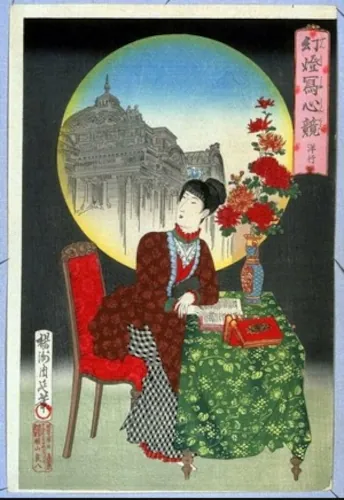
The Meiji-era ukiyo-e artist Yōshū Chikanobu created a series called Gentō Shashin Kurabe, in which circular magic-lantern images appear within the prints, showing various worlds that women might have dreamed of or longed to see.
Looking at these images gives us a glimpse of the kinds of worlds that may have captured the imagination of women living in this rapidly changing era.
- The Magic Lantern: A New Way of Seeing Together
- The World They Wanted to See
- “I Want to Travel Abroad” — Journeys to the West
- Women Speaking in Public — “Speeches by Women”
- Hot Springs, Theaters, and River Festivals — Women Enjoying Life
- Was the Circle of Light a Screen for the Future?
- What Did People See Before Cinema?
The Magic Lantern: A New Way of Seeing Together
Japan already had various forms of visual entertainment before the magic lantern appeared.
During the Edo period, for example, people enjoyed nozoki karakuri, viewing devices in which they looked through an opening into a box to see an illustrated scene.
The magic lantern was different.
It enlarged an image and allowed many people to look at the same picture together.
A darkened room.
A screen.
A circle of light appearing before the audience.
And within that circle, unfamiliar places and people coming into view.
This was a new experience of sharing an image with others, one that has something in common with the experience of watching a film in a modern cinema or viewing a projected presentation.
The magic lantern was therefore more than a piece of technology. It was a new medium that helped change the way people experienced images.
The World They Wanted to See
One work that beautifully symbolizes this idea is Yōshū Chikanobu’s Gentō Shashin Kurabe.
In these prints, the circular glow of the magic lantern—a popular visual technology of the time—is incorporated into the composition.
Within these circles appear scenes that evoke the dreams and aspirations of women.
Chikanobu was not simply depicting the magic lantern itself.
He was using its distinctive circle of light to express what a woman might wish to see.
The circle becomes both a screen showing another place and a window into the imagined world of the woman looking at it.
So what kinds of worlds appear within these circles?
“I Want to Travel Abroad” — Journeys to the West
One theme is travel abroad.
During the Meiji era, the West was becoming increasingly familiar to people in Japan, even though actual overseas travel remained beyond the reach of most people.
Foreign landscapes therefore became objects of fascination and longing.
When an image of a foreign place appeared within the circle of a magic lantern, viewers could imagine that place even without actually traveling there.
For a Meiji woman, the foreign world shown in such an image may have represented more than a tourist destination.
It could have suggested something beyond her immediate surroundings:
A world I have never seen lies beyond this place.
That sense of possibility may have been part of the attraction.
Women Speaking in Public — “Speeches by Women”
Another particularly interesting theme is women giving public speeches.
This was very different from scenes of leisure or fashion.
Here, women are shown standing before an audience and speaking in their own voices.
During the Meiji era, women speaking publicly was not yet as familiar a sight as it is today.
The image of a woman giving a speech could therefore symbolize the changing possibilities of the new era.
The women appearing within the magic-lantern circles are not simply beautiful figures.
They also represent women whose lives and roles were changing as Japan entered the age of bunmei kaika, or “civilization and enlightenment.”
Hot Springs, Theaters, and River Festivals — Women Enjoying Life
At the same time, the worlds depicted in the series are not limited to grand visions of the future.
They also include scenes connected with leisure and everyday life, such as hot springs, yose theaters, and river festivals.
This is another fascinating aspect of the series.
The things that women might long for were not limited to overseas travel or greater participation in society.
They could also include ordinary pleasures:
Visiting a hot spring.
Enjoying a performance at a yose theater.
Watching a river festival.
Going out with friends or family.
These everyday experiences were also part of the world that women of the new era could imagine for themselves.
In other words, Gentō Shashin Kurabe is not simply a story about Westernization.
A fascination with foreign countries, images of women participating in public life, and familiar forms of entertainment all appear within the same circles of light.
Together, they reveal the many different kinds of “newness” that characterized the Meiji era.
Was the Circle of Light a Screen for the Future?
Let us look once more at the circular light of the magic lantern.
In an actual magic-lantern presentation, photographs or illustrations were projected within a circle of light.
But in Gentō Shashin Kurabe, the circle itself represents an imagined world.
It is therefore more than a decorative element.
It seems to function as a window onto a world different from the reality of the moment.
The scenes may not simply represent things that women of the time were already experiencing. They may also suggest experiences they hoped to have, or new possibilities for women’s lives that were beginning to emerge in the Meiji era.
The magic lantern projected things that people had never seen before into the darkness.
Perhaps that is why its light could also become a tool for imagining the future.
What Did People See Before Cinema?
Today, we can open a smartphone and see photographs and videos from around the world.
A foreign city or an event from centuries ago can appear instantly on a screen.
But before cinema became widely established, people were already enjoying the experience of seeing another world appear within a circle of light.
The magic lantern was a form of entertainment and an educational tool.
And in Yōshū Chikanobu’s Gentō Shashin Kurabe, its circular light also became a screen upon which the dreams and aspirations of Meiji women could be imagined.
The worlds within those circles were not limited to distant foreign countries.
They included women speaking in public.
Women enjoying hot springs.
Women visiting yose theaters.
Women watching river festivals.
Together, they seem to ask a fascinating question:
What kind of world would a woman of the new era see, and how might she choose to live in it?
Long before cinema became widespread in Japan, people sat in the darkness and watched circles of light reveal worlds they had never seen.
Those small circles of light were part of the visual culture that would eventually lead toward cinema.
At the same time, they became dream screens, reflecting the new worlds that Meiji women could imagine for themselves.
References
- Tokyo Museum Collection: https://museumcollection.tokyo/works/6242856/
- Yokohama Museum of Art – Viewing Guide: https://yokohama.art.museum/special/2017/fashionandart/pdf/yoshu_2.pdf
- Komura Kobune, Stories of Meiji-Era Youth Culture