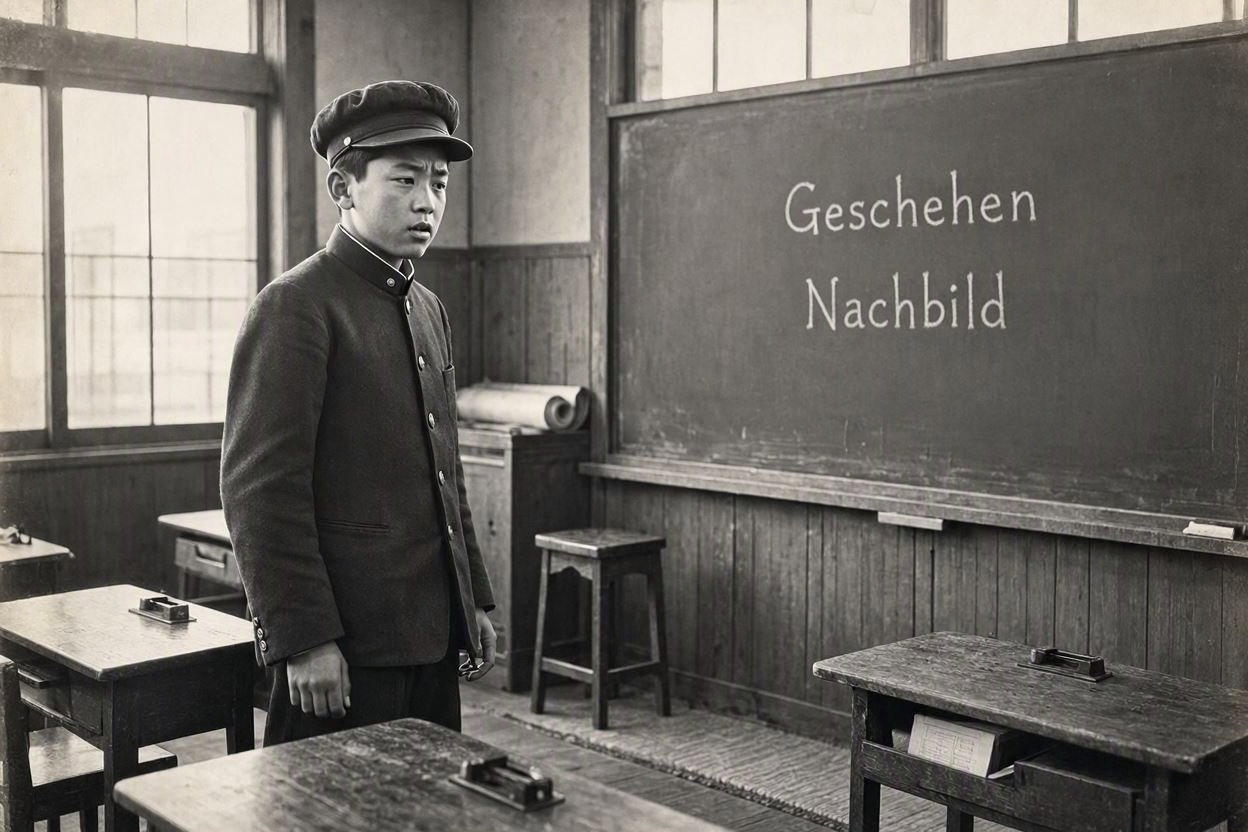
Sanshiro is attending a lecture on literary theory at Tokyo Imperial University. On the blackboard, he sees two German words:
Geschehen and Nachbild.
But when the professor enters the classroom, he looks at the words and says, “Oh, German,” then laughs and quickly erases them.
Sanshiro feels that, because of this, he has lost a little of his respect for the German language.
Natsume Soseki’s Sanshiro was published in 1908, in the 41st year of the Meiji era. Japan was approaching the end of the Meiji period, just before the Taisho era began.
This scene gives us a glimpse of German being used in the academic world of Japanese universities at the time.
But students were not only studying foreign languages.
As they spent time together at school and in dormitories, they also created their own unusual words—expressions that might only make sense to other students.
Some came from German.
Some were ordinary Japanese words with a twist.
And some were surprisingly dramatic expressions.
One of the most interesting examples is “tankiensei” (単騎遠征).
“Tankiensei” Meant Going to the Dining Hall Alone
When you hear the phrase tankiensei, what kind of scene do you imagine?
The original meaning of tankiensei was something much more dramatic: going alone, or on a single horse, toward a distant place or even into enemy territory.
But students at the old higher schools used the expression for something much more ordinary:
Going to the dining hall alone.
In other words, a student might say:
“I’m going on a tankiensei.”
And simply mean:
“I’m going to eat by myself.”
The Old Higher School Memorial Museum introduces tankiensei in its collection of old student slang, defining it as “going alone to a dining hall or similar place.” The collection also includes many other expressions created by students, including both German-based words and Japanese wordplay.
The original phrase tankiensei sounds brave and heroic.
The students, however, used it for the small everyday act of going somewhere alone to eat.
They took a grand expression and applied it to an ordinary situation.
That kind of wordplay feels very much like something students would enjoy.
German Became Student Slang, Too
German also found its way into the language of students at the old higher schools.
According to the Old Higher School Memorial Museum, many students studied German as their first or second foreign language. This helped German-based expressions become part of student slang.
For example:
- Mädchen — a young woman
- Schan — a beautiful woman
- Dopperi — to repeat a school year
- Ji — an expression used when making a request
- Gerupin — being short of money
Students did not simply use German words as they were.
They brought German into Japanese conversation and gave the words their own meanings within student life.
But student slang was not all about German.
For example:
- Demo-shū (でも秀) — a student who did very well on the entrance exam but performed poorly after entering school
- Yūnō da (有能だ) — meaning “wonderful” or “great”
- Ura-omote yaru (裏表やる) — to repeat the same school year twice
- E-eh (エッエッ) — from etsu (悦), meaning great joy or delight
In other words, students played with both foreign languages and their own language, creating expressions that belonged to their own circle.
Why Did Students Create Such Strange Words?
It wasn’t just male students; female students in the Meiji era also enjoyed using unique words and ways of speaking.
The phrase “Yokuutte yo” (“That’s perfectly fine!”)offers a glimpse into the world of female students at that time.
So, why did students at the old-system high schools come up with such unique expressions?Students at the old higher schools did more than attend classes. Many also lived together in dormitories.
When people go through the same experiences and spend so much time together, they naturally develop words that only their friends understand.
Mixing in German.
Changing ordinary Japanese words.
Using deliberately grand expressions.
These words were more than simple slang. They may have been part of the students’ close relationships and their student culture itself.
Even today, people use words that only make sense within a particular hobby or community.
Perhaps students a hundred years ago enjoyed creating their own “language of friendship” in much the same way.
Is “Tankiensei” Still Used Today?
Interestingly, the expression tankiensei can still be found in Japanese today.
For example, some people use it when they travel alone to attend a concert or other event.
However, we cannot say for certain that this modern use was directly inherited from student slang of the Taisho or early Showa periods.
Even so, there is an interesting similarity.
Using a slightly dramatic expression for the simple act of going somewhere alone.
Language changes with time.
But the habit of young people creating unusual words within their own groups—and having fun with them—may be much older than we think.
What Can “Tankiensei” Tell Us About Students?
When we think about students at the old higher schools, we may picture elite young men who had passed difficult entrance examinations, studied hard, and sang school dormitory songs.
But these words show us another side of their lives.
Going to eat alone.
Using words that only their friends understood.
Mixing foreign languages into everyday conversation.
Making deliberately dramatic jokes.
These students were not simply “students of the past” as one uniform group.
They were ordinary young people who laughed with their friends, had fun, and sometimes tried to look a little cool.
Following the words they left behind gives us a glimpse of student life in Japan about a hundred years ago—a side of everyday life that textbooks and photographs cannot always show us.
References
- Hiroshi Takeuchi, The Glory and Setback of the Academic Elite, Chūō Kōron Shinsha, 1999.
- Junichi Mizuno, A Youthful Memoir of Cooking at an Old Higher School, Tōyō Keizai Shinpōsha, 1984.
- Koji Masahashi, Hokushin Shikashū, Enlarged Edition, Katsura Shobō, 1991.