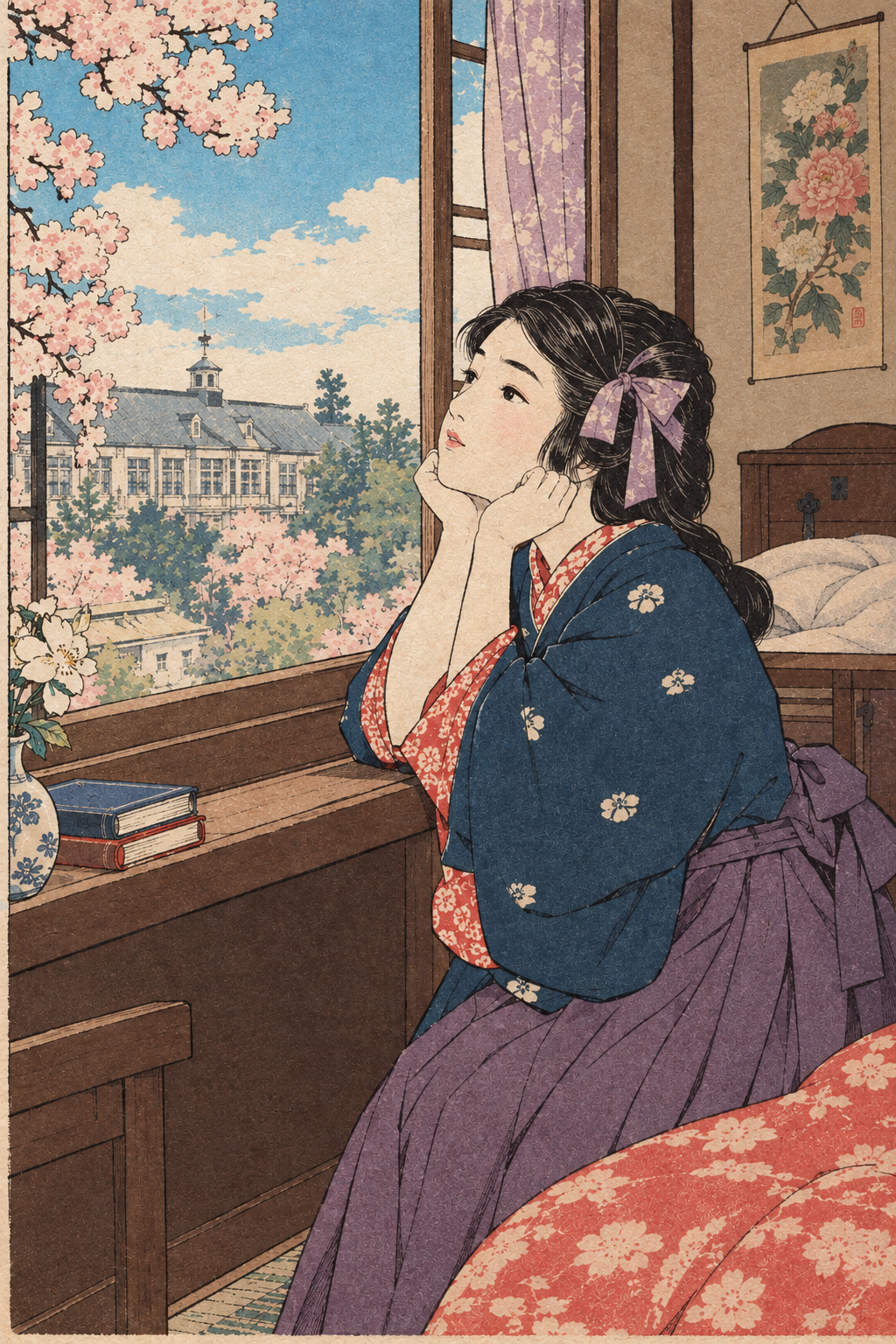
When you think of a Japanese girls’ school, you may imagine schoolgirls walking through the school gates in hakama, traditional divided skirts worn with kimono.
But some girls who traveled from far away to attend girls’ schools lived in school dormitories.
So, what was everyday life like for these students?
In fact, school dormitories had more than just bedrooms. They included study rooms, dining rooms, bathrooms, sickrooms, and other spaces. They became another place where students lived their daily lives, separate from the school itself.
Living Away from Home to Attend Girls’ School
From the Meiji to the Taisho period, higher girls’ schools and other schools for girls were established in many parts of Japan. As a result, some girls left their hometowns to continue their education.
For these students, the school dormitory was their home while they attended school.
For example, at Doshisha Girls’ School in 1893, there were 16 day students and 62 boarding students. About 80 percent of the students lived in the dormitory.
For girls who came from distant places, school dormitories were an important part of everyday life.
What Was Inside a School Dormitory?
The 1899 regulations for higher girls’ schools stated that prefectural higher girls’ schools should, in principle, have dormitories.
The dormitories were required to have facilities such as:
- Study rooms
- Bedrooms
- A dormitory supervisor’s room
- A reception room
- A sickroom
- A dining room
- A hairdressing room
- Bathrooms
- Washing areas
In other words, a dormitory was not simply a place to sleep at night.
Students studied, ate their meals, took care of themselves, and rested when they became ill.
It was a place where they spent a large part of their daily lives.
Life Under the Watch of a Dormitory Supervisor
Of course, dormitory life was not completely free.
A dormitory supervisor was responsible for watching over the students and managing their daily lives.
After spending the day in class, a student might return to the dormitory—only to find another teacher waiting there.
That must have kept everyone on their best behavior!
Interestingly, at some schools, students themselves also had roles in managing dormitory life.
At Atomi Girls’ School, a photograph from 1914 shows students known as shitsubo.
These students were chosen from among the girls in each room. They were responsible for helping their roommates with things such as personal appearance and studying.
So, dormitory life was not managed by teachers alone. The students themselves also took part in running their shared community.
More Than Studying
Self-study was an important part of dormitory life.
But studying was not the only thing students did there.
At Japan Women’s University, a dormitory established in 1901 was described not simply as a place to live, but as a place for “practical training in daily life.”
The students lived together like a family under the supervision of a dormitory director, and each student was given responsibilities within the community.
In other words:
Living together was itself part of their education.
A Small Society of Schoolgirls
Imagine a group of girls living under the same roof and attending the same school.
They woke up in the morning, ate together, went to school, returned to the dormitory, and studied.
As they repeated this routine day after day, friendships naturally developed.
The dormitory must have become a small society of its own—a place that was somewhat different from the “school” seen by their teachers.
Research on dormitory life at higher girls’ schools in the Taisho and early Showa periods also considers dormitories an important part of understanding girls’ secondary education.
The world of girls’ schools later became a recurring setting for stories about friendship and relationships between girls.
When we think of works such as Nobuko Yoshiya’s Hana Monogatari, the girls’ novel Clara Hakusho, or Maria-sama ga Miteru, we can see how the girls’ school became a popular setting for stories about friendship and relationships.
However, we should not simply equate these fictional worlds with actual dormitory life in the Meiji and Taisho periods.
The “girls’ school” of literature and fiction was not the same as the real everyday lives of schoolgirls.
Still, why do we tend to imagine a special world of dormitories, girls, and friendships when we hear the words “girls’ school”?
One part of the answer may be found in the real dormitories where schoolgirls once lived together under the same roof.
Another School Outside the Classroom
For schoolgirls, the dormitory was the place they returned to after school. At the same time, it was another place where they learned different things.
They learned to follow the rules of communal life.
They learned to take care of themselves.
They learned how to get along with their friends.
And sometimes, while keeping an eye on their teachers, they also enjoyed time that belonged just to themselves.
The “school life” we imagine for these girls did not end inside the classroom.
To understand the daily lives of schoolgirls, perhaps we need to look beyond the classroom—and into the dormitory as well.
References
- Ministry of Education, “Regulations Concerning the Organization and Facilities of Higher Girls’ Schools (excerpt),” February 9, 1899.
- Doshisha Women’s University, “Development of Specialized Education — Dormitories,” 125-Year History of Doshisha Women’s University.
- Atomi University Kakei Memorial Museum, “Dormitory Room Mothers and Dormitory Supervisor Riko, 1914,” 1914.
- Naruse Memorial Museum, Japan Women’s University, “Mejiro Campus (Prewar),” Digital Archive.
- Kang Hwa, “Girls’ Secondary Education in the Taisho and Early Showa Periods: Focusing on Dormitory Life,” Bulletin of the Waseda University Society of Education, No. 16, 2014, pp. 71–78.