During the Meiji era, women’s hairstyles in Japan gradually began to change. Influenced by Western culture, a new style known as sokuhatsu became popular. Unlike traditional Japanese hairstyles, it offered a different way of arranging the hair.
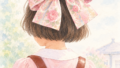
There were many variations of sokuhatsu, and these styles attracted attention as a new form of personal grooming for women. Ribbons were among the accessories used to decorate these hairstyles.
What kinds of hairstyles did girls enjoy, and how did they wear ribbons in their hair?
From Traditional Japanese Hairstyles to Sokuhatsu
During the Meiji era, Western culture and ways of life began to spread throughout Japan. Women’s hairstyles also changed, and sokuhatsu, which differed from traditional Japanese hairstyles, attracted growing interest.
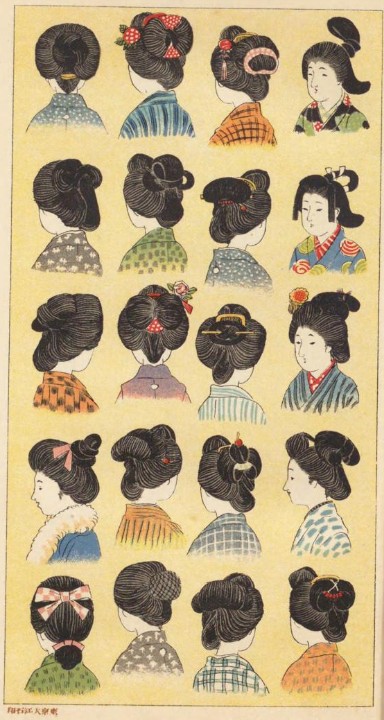
There were many variations of sokuhatsu. Nishiki-e woodblock prints depicting hairstyles around 1885, along with illustrated guides such as Dai Nihon Fujin Sokuhatsu Zukai (An Illustrated Guide to Women’s Hairstyles in Japan), show that these new hairstyles came in a variety of styles rather than just one.
These changes involved more than appearance alone. As new ways of life and new values spread, women’s approaches to personal grooming also began to change.
Ribbons to Decorate Sokuhatsu
Alongside sokuhatsu, ribbons are another detail worth exploring.
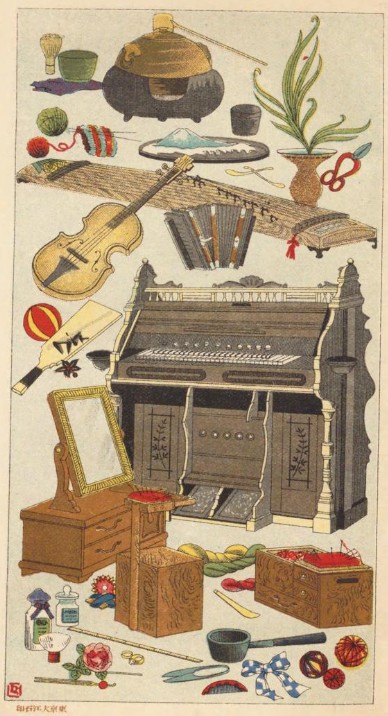
Meiji Shōjo Setsuyō, published in 1907 and available through the National Diet Library Digital Collections, contains a color illustration page titled “Girls’ Accessories.” It depicts items associated with girls’ daily lives, including sewing tools, scissors, combs, and ribbons.
This page offers a glimpse into the world of objects that surrounded girls in the late Meiji era. However, the items shown in a book were not necessarily equally familiar or accessible to every girl.
A ribbon may be a small item used to decorate the hair. Yet when we look at the culture of female students at the time, it cannot be dismissed as a simple ornament.
What Ribbons Symbolized
In her paper “The Ribbon of Female Students: Changes in Modern Women’s Morality as Seen Through Clothing,” Yukiko Kagawa points out that ribbons symbolized female students from wealthy urban families who had acquired knowledge of modern Western culture. For men who admired these young women, ribbons could also represent social status and economic means.
In other words, a ribbon was not only part of a girl’s fashion. It could also suggest something about her background and the world she belonged to.
Attending school as a female student was also connected to family finances and educational opportunities. Not every girl had the same opportunities to enjoy fashionable hairstyles and accessories.
Behind a small ribbon, we can glimpse not only the lives of girls but also the society they lived in and the aspirations of those around them.
What Hairstyles Reveal About Girls’ Culture in the Meiji Era
Sokuhatsu and ribbons offer a glimpse into the changing world of women’s fashion during the Meiji era.
Trying a new hairstyle. Decorating the hair with a ribbon. And seeing these choices take on special meanings in the eyes of others.
Even a single hairstyle or a small accessory can help us think about what people admired and how they lived in the past.
For female students in the Meiji era, a ribbon may have been an important accessory that allowed them to express their individuality.
Do you remember longing for a beautiful ribbon when you were a child?
References
- Kagawa, Yukiko. “The Ribbon of Female Students: Changes in Modern Women’s Morality as Seen Through Clothing.” Tokyo Woman’s Christian University Review, Vol. 60, No. 2, 2010, pp. 291–307.
- Watanabe, Yukie. “The Promotion of Sokuhatsu Hairstyles in the Meiji Period: Focusing on Jogaku Zasshi.” Journal of Women’s History, No. 10, 2000, pp. 49–63.
- Iwaya Sazanami et al., eds. Meiji Shōjo Setsuyō. Hakubunkan, 1907. National Diet Library Digital Collections: Meiji Shōjo Setsuyō
- Pola Research Institute of Beauty and Culture. “Hairstyles in the Meiji Era, Part 1.”
- Suntory Museum of Art. “Nihon Seiyō Fujin Sokuhatsu Zukai” (Illustrated Guide to Japanese and Western Women’s Hairstyles). Exhibition artwork commentary.