The Surprising History Since the Meiji Era
Dropping an egg into a bowl of soba may seem completely ordinary today.
But eggs were not always an everyday food in Japan.
By the Edo period, eggs were already being sold by street vendors. Yet they were expensive and considered a valuable food for ordinary people.
Even after the beginning of the Meiji era (1868–1912), eggs did not immediately become cheap or readily available.
Something began to change, however, during the Meiji and Taisho eras (1912–1926).
Chickens were increasingly raised by farmers, eggs were collected and sold as a source of income, and eventually they were transported from rural areas to growing cities.
In other words, eggs were gradually becoming part of Japan’s urban food culture.
Eggs Were Expensive in the Early Meiji Era
According to The History of Prices in the Meiji, Taisho, and Showa Eras, around 1877, 100 monme of eggs cost 10 sen, while a bowl of soba cost 8 rin.
One hundred monme was about 375 grams. If we roughly think of this as about six modern-sized eggs, the prices were:
- Six eggs: 10 sen
- One bowl of soba: 0.8 sen
That means one egg cost about 1.67 sen—roughly the same as two bowls of soba.
Of course, we cannot simply convert these prices into today’s money. The comparison also does not tell us the absolute value of eggs at the time.
Still, it gives us a sense of how expensive eggs were compared with an ordinary meal.
Eggs had been a valuable food since the Edo period, and the beginning of the Meiji era did not suddenly make them an everyday ingredient.
So how were eggs produced?
Chickens in the Farmyard
Looking at Okayama Prefecture gives us a glimpse of what poultry farming was like at the time.
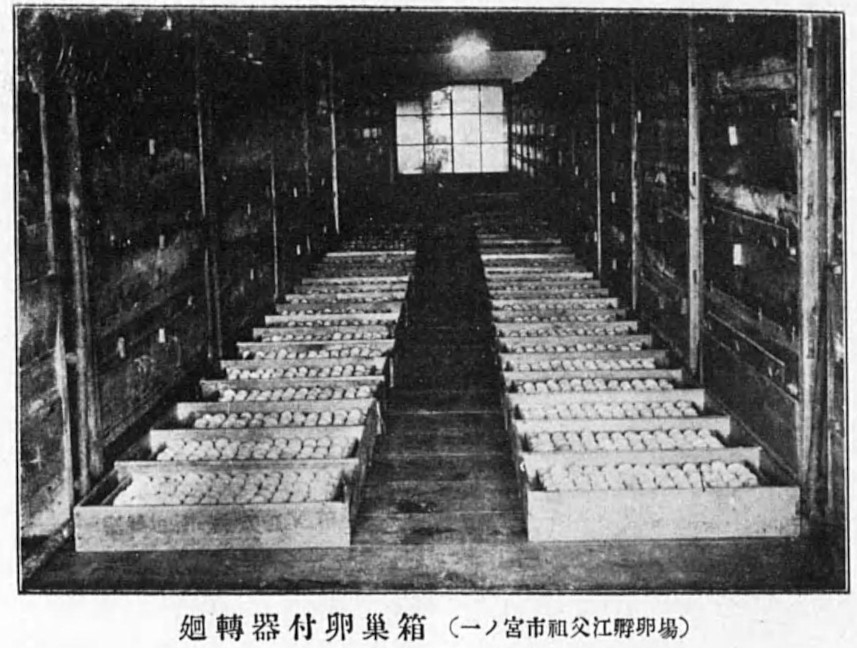
During the Meiji and Taisho eras, raising chickens was largely a side business for farming households. Many families kept just a few chickens in their yards—typically one rooster and two or three hens.
The eggs were collected over several days and then sold. For farmers, eggs could provide a valuable source of cash income.
In the Meiji era, poultry farming in Okayama was still small in scale. But from around the 1880s onward, efforts to improve poultry farming began to spread.
Agricultural associations encouraged farmers to raise chickens, and poultry organizations and exhibitions were established. In 1903, for example, the Kawakami Agricultural Association encouraged households to keep chickens as a side business and offered prizes for those whose hens laid the most eggs.
The change was gradual.
Rather than large farms producing huge quantities of eggs, many small farming households produced a little each.
That created a new question:
How could all those eggs reach the people who wanted to buy them?
Eggs Begin Moving to the Cities
Producing more eggs was only part of the story.
The eggs also had to be collected, traded, transported, and sold.
By the Taisho era, this distribution system was becoming more developed in Okayama.
In 1922, poultry markets were established in various parts of the prefecture, and eggs and chickens were traded there. Around 500 tons of eggs a year were being shipped to the Keihanshin area, including Osaka and Kobe.
The following year, statistics show that approximately 1,312 tons of eggs from Okayama were shipped to the Hanshin market, where they were sold under the brand name Bicchu eggs. At the time, Okayama produced about 1,875 tons of eggs a year.
This is an important change.
Eggs were no longer simply something produced and consumed within the same farming community.
They were becoming a commercial food product connecting rural producers with urban consumers.
Transportation was an important part of this process. Areas with better transportation links had an advantage in collecting eggs and sending them to large markets.
The eggs laid by chickens in farmyards were gradually entering a much larger system of production, trade, and consumption.
Did Eggs Become Cheaper Compared with Soba?
Now let’s look again at the historical prices.
Around 1913, 100 monme of eggs cost 20 sen. A bowl of soba cost 4 sen around 1917.
Again, if we think of 100 monme as roughly six eggs:
- Six eggs: 20 sen
- One bowl of soba: 4 sen
One egg would therefore cost about 3.3 sen—slightly less than one bowl of soba.
Compare that with the early Meiji period:
Around 1877:
One egg ≈ two bowls of soba
Around the Taisho period:
One egg ≈ 0.8 bowl of soba
These figures come from different years, so they should not be treated as a precise measure of changes in the cost of living. Regional differences also matter.
But they offer an interesting clue.
The price of eggs itself had risen, yet their relative price compared with soba had changed considerably.
As poultry farming expanded and eggs began moving from production areas to urban markets, eggs may have been gradually losing their status as a special food and becoming a more familiar part of everyday life.
When Eggs Became Part of Urban Food Culture
Dropping an egg into a bowl of soba seems like a simple thing today.
But behind that one egg was a growing network of farmers, traders, markets, transportation, and urban consumers.
Eggs had been expensive since the Edo period. They did not suddenly become cheap when Japan entered the Meiji era.
Instead, as poultry farming developed and distribution networks connected rural production areas with growing cities, eggs gradually became easier for urban consumers to obtain.
A food that had once been a valuable source of nourishment was becoming part of everyday life.
And perhaps this is part of the story behind tsukimi soba—a simple bowl of soba topped with an egg.
The egg on top may look ordinary today.
But it reflects a much larger transformation in Japan’s food culture: the transformation of food from something produced locally into something that could be produced, transported, sold, and consumed across a rapidly modernizing country.
References
- Shukan Asahi, ed. The History of Prices in the Meiji, Taisho, and Showa Eras, Vol. 1. Asahi Shimbunsha, Asahi Bunko, 1987.
- History of Livestock Farming in Okayama Prefecture, Chapter 4, “Development of Poultry Farming.”
- Ministry of Agriculture, Forestry and Fisheries, Nippon Traditional Food Encyclopedia, “Livestock Products.”