Have you ever watched The Wind Rises and wondered, “What is that?”
There is a strange, triangular sweet that Jiro Horikoshi and the other characters are eating.
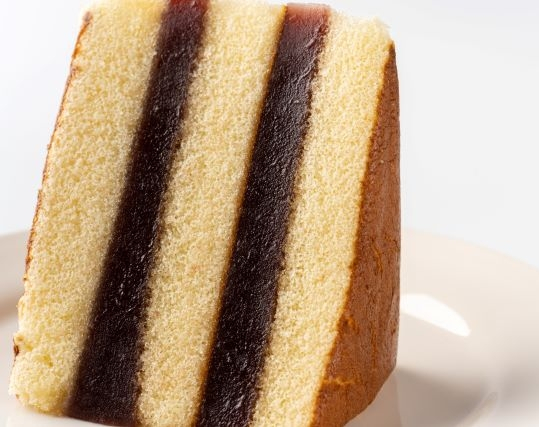
It is called Siberia.
It is made by sandwiching yokan, a traditional Japanese sweet bean jelly, between layers of castella-like sponge cake.
When you think about it, it is quite a surprising combination.
Both castella and yokan had already been known in Japan for a long time. Yet, at some point, someone decided to put the two together and create a new sweet.
In other words:
Castella + yokan = a sinful combination.
And Japan produced another, very similar combination:
Bread + anko = anpan.
Wheat-based bread from the West was combined with anko, the sweet bean paste that Japanese people had enjoyed for generations.
The Strange Sweet Called Siberia
The exact origins of Siberia are actually unclear.
There are several theories about when and where it was first made, and there is no established explanation for the origin of its name.
What we do know is that it became popular from the Taisho period into the early Showa period.
Its basic form is surprisingly simple:
Yokan sandwiched between layers of castella.
Castella is a Western-style cake made with ingredients such as wheat flour, eggs, and sugar.
Yokan, on the other hand, is a traditional Japanese sweet made with anko.
In other words, Siberia combines a Western-style cake with a traditional Japanese sweet.
And that is what makes it so interesting.
Both castella and yokan have long histories of their own.
Yet, at some point in Japan, someone decided to put them together.
We do not know who came up with the idea, but the result was the unusual sweet we now know as Siberia.
And this kind of combination—a wheat-based food + anko—was not limited to Siberia.
Another “Sinful Combination”: Anpan
Another familiar example is anpan, a sweet bread filled with anko.
Bread was a relatively new food for Japanese people.
Bread had been known in Japan since the early modern period, but as Western food culture spread during the modern era, bread gradually became part of urban life.
Then, in 1874, Kimuraya began selling anpan.
Bread with anko inside.
Today, the combination is so familiar that we hardly think twice about it.
But when you stop and think about it, it was quite a bold idea.
Bread came from the West.
Anko was a sweet that Japanese people had enjoyed for a long time.
Someone simply put the two together.
How Did Japanese People Traditionally Eat Anko?
Let us take a small step back.
Long before anpan appeared, Japanese people already had a tradition of combining anko with other foods.
Anko was wrapped in foods such as mochi and manju, or served with dango and mochi.
So when wheat-based bread began to spread in modern Japan, the idea of
“Why not put anko in bread?”
may not have seemed completely unfamiliar.
Of course, that does not mean that anpan was simply created as a “wheat version of daifuku.”
There is no confirmed historical lineage showing that anpan developed directly from daifuku.
Still, it is fascinating that a new food from the West was combined with a familiar Japanese flavor: anko.
Bread Did Not Become Japan’s Staple Food. But…
In my previous article, I looked at why bread never became Japan’s staple food.
Rice had long held an important place as a staple in Japan.
So bread, which came from the West, never replaced rice as the main staple.
But that does not mean that Japanese people simply rejected bread.
They put anko inside it.
They made bread into something that felt more familiar to Japanese tastes.
Siberia is somewhat similar.
Castella and yokan.
A Western-style cake and a traditional Japanese sweet.
Two foods that already existed separately were brought together to create something new.
Rather than simply accepting foods from overseas as they were, people in Japan sometimes combined them with flavors they already knew and enjoyed.
Siberia and anpan may be small examples of this kind of food culture.
Wheat and Anko
At first glance, wheat and anko may seem like a slightly strange combination.
But these sweets exist because people in the past thought, “Maybe these two things would taste good together.”
And I think that is rather fun.
We can still enjoy the combination of anko and wheat today, in anpan and other sweets.
Thanks to those slightly daring combinations created by people in the past, we can enjoy something delicious today.
So the next time you eat anpan, perhaps it will taste just a little more interesting.
After all, knowing the story behind a food can make it taste even better.
References
- Satoshi Okada (ed.), A Dictionary of Wheat Food Culture, Tokyo-do Publishing, 2001.
- Masato Oyama, The Anpan Story of Ginza Kimuraya, Heibonsha, 2001.
- Reiko Tanabe, Bread: A Cultural History of Things and Humanity, Vol. 80, Hosei University Press, 1995.
- Tokyo Nichinichi Shimbun (ed.), A Guide to the Best Foods in Greater Tokyo, Marunouchi Publishing, 1933.