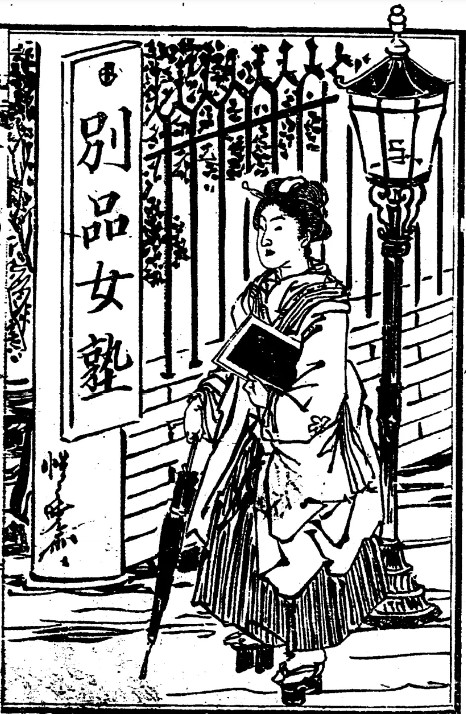
When we think of girls in Meiji and Taisho Japan, many people may picture female students walking to school in hakama.
But not every girl was a student.
So, what kind of girls went on to attend a girls’ school?
What Kind of Schools Did Girls Attend?
The modern school system offered somewhat different paths for boys and girls.
For boys, there was a path from elementary school to middle school, then to higher school and university.
For girls, one of the main paths to further education was the higher girls’ school, or koto jogakko.
| School | Approximate age |
| Elementary school | About 6–12 |
| Higher girls’ school | About 12–17 |
| Girls’ vocational schools and other higher education institutions | About 17 and older |
It is important to remember that a higher girls’ school was not the same as a modern Japanese high school.
And graduating from elementary school did not mean that every girl went on to a higher girls’ school.
The school system in modern Japan differed significantly for boys and girls. Here, we will focus on the educational path for girls.
Did Every Girl Go to a Girls’ School After Elementary School?
No.
For many girls at the time, finishing elementary school marked the end of their formal education.
After that, some helped with housework, some worked, and others learned housework, sewing, and other skills in preparation for marriage.
At the same time, some girls chose to continue their education.
Going to a girls’ school required more than simply being old enough. Families needed to pay tuition, and a girl needed time to attend school and support from her family.
If there was no girls’ school nearby, she might even have to leave home and live in a school dormitory.
In other words, it was not simply a matter of turning twelve and going to a girls’ school.
Girls’ Schools Gradually Became More Common
Even so, the situation surrounding girls’ secondary education changed greatly from the Meiji to the Taisho period.
The number of higher girls’ schools increased, and the number of girls attending them grew rapidly.
In 1913, during the Taisho period, about 68,000 girls were students at higher girls’ schools.
By 1926, the number had risen to about 300,000.
The female student, or jogakusei, gradually became a more familiar figure in Japan from the late Meiji period into the Taisho period.
What Kind of Family Did These Girls Come From?
There is no single answer to this question.
Some came from relatively comfortable families. Some had parents who placed a high value on their daughters’ education.
Others hoped to use their education to pursue careers such as teaching.
And every family had its own circumstances.
For example, the writer Koda Aya lost her mother when she was six years old. Her father, the writer Koda Rohan, later remarried, and Aya grew up in a new family environment.
She attended Joshi Gakuin.
Koda Aya’s family was certainly not a typical example of every girl who attended a girls’ school.
But her story reminds us that a girl’s path to education could be shaped not only by the family’s financial situation, but also by her parents’ attitudes, family circumstances, and the people around her.
Girls of the Same Age Could Live Very Different Lives
Imagine two girls who were both fourteen years old.
One attended a higher girls’ school, where she studied Japanese, mathematics, sewing, music, and foreign languages.
The other might have helped with housework, worked, or prepared for marriage.
Even though they were the same age, their daily lives could be completely different.
The growth of girls’ schools and the increasing number of female students meant that new educational paths were becoming available to girls in modern Japan.
But this path was still not open to every girl.
That is why, when we look at the female student of the Meiji and Taisho periods, it is worth looking beyond the uniform and hakama and asking:
Why was this particular girl able to go to a girls’ school?
Once we ask that question, the image of the female student begins to look a little different.
And what did these girls learn at school? What was their daily life like?
There was another side of modern Japan waiting to be discovered in their classrooms and dormitories — sewing, foreign languages, friendships, and the unique words and fashions of female students.
References
- Kyoko Inagaki, Jogakko to Jogakusei: Kyōyō, Tashinami, Modan Bunka [Girls’ Schools and Female Students: Education, Refinement, and Modern Culture], Chuo Koron Shinsha, 2007.
- Ministry of Education, Gakusei Hyakunen-shi [A History of One Hundred Years of the Japanese Education System], Teikoku Chiho Gyosei Gakkai, 1981.
- National Archives of Japan, “Koto Jogakko Rei” [Higher Girls’ School Ordinance], 1899.