“Delicious!”
In Demon Slayer: Kimetsu no Yaiba – Mugen Train Arc, there is a memorable scene in which Kyojuro Rengoku eats bento on the train.
And Rengoku does not eat just one or two.
A vendor brings boxes of bento onto the train, and Rengoku eats one after another.
For many people in Japan, eating a bento on a train is not an unusual sight.
You buy a bento at the station.
You get on the train.
You open the bento in your seat.
For a long time, this has been part of traveling in Japan.
But when did this custom begin?
And how much did a bento like the one Rengoku eats cost at the time?
The Beginning of Ekiben
Today, the bento sold at Utsunomiya Station in 1885, during the Meiji period, is widely known as the first ekiben in Japan.
It was not a fancy makunouchi bento like many ekiben today.
It was very simple: two rice balls with umeboshi, or pickled plums, and some pickles.
The price was said to be 5 sen.
However, there are other theories about where the first ekiben in Japan was sold.
For this reason, rather than saying that this was definitely the first ekiben in Japan, it is safer to describe the Utsunomiya Station bento as the origin that is now most widely known.
In any case, the rise of ekiben was closely connected to the development of railways.
Railways Created a New Place to Eat
As railways developed, people could travel farther and faster than before.
But when people traveled long distances by train, they naturally became hungry.
This led to a new style of eating:
buying food at a station and taking it onto the train.
Stations became more than places where people got on and off trains. They also became places where travelers could buy food for their journey.
Bento were also made in a form that was easy to carry and eat on a train.
This new form of transportation created new food habits as well.
How Much Did an Ekiben Cost?
This raises an interesting question: how expensive was an ekiben for people at the time?
According to prices listed in Price History of the Meiji, Taisho, and Showa Periods, an ekiben at Utsunomiya Station cost 5 sen in 1885.
By comparison, a bowl of soba cost 1 sen in 1887.
Simply comparing the prices, the ekiben cost five times as much as a bowl of soba.
Of course, an ekiben and a bowl of soba were different in size and contents.
Still, it would be misleading to think that an ekiben was simply a very cheap meal that anyone could easily buy while traveling.
Prices changed as time passed.
In 1917, a makunouchi bento cost 15 sen.
A bowl of soba cost 4 sen.
The makunouchi bento was about 3.75 times the price of soba.
And this brings us back to Rengoku in Demon Slayer.
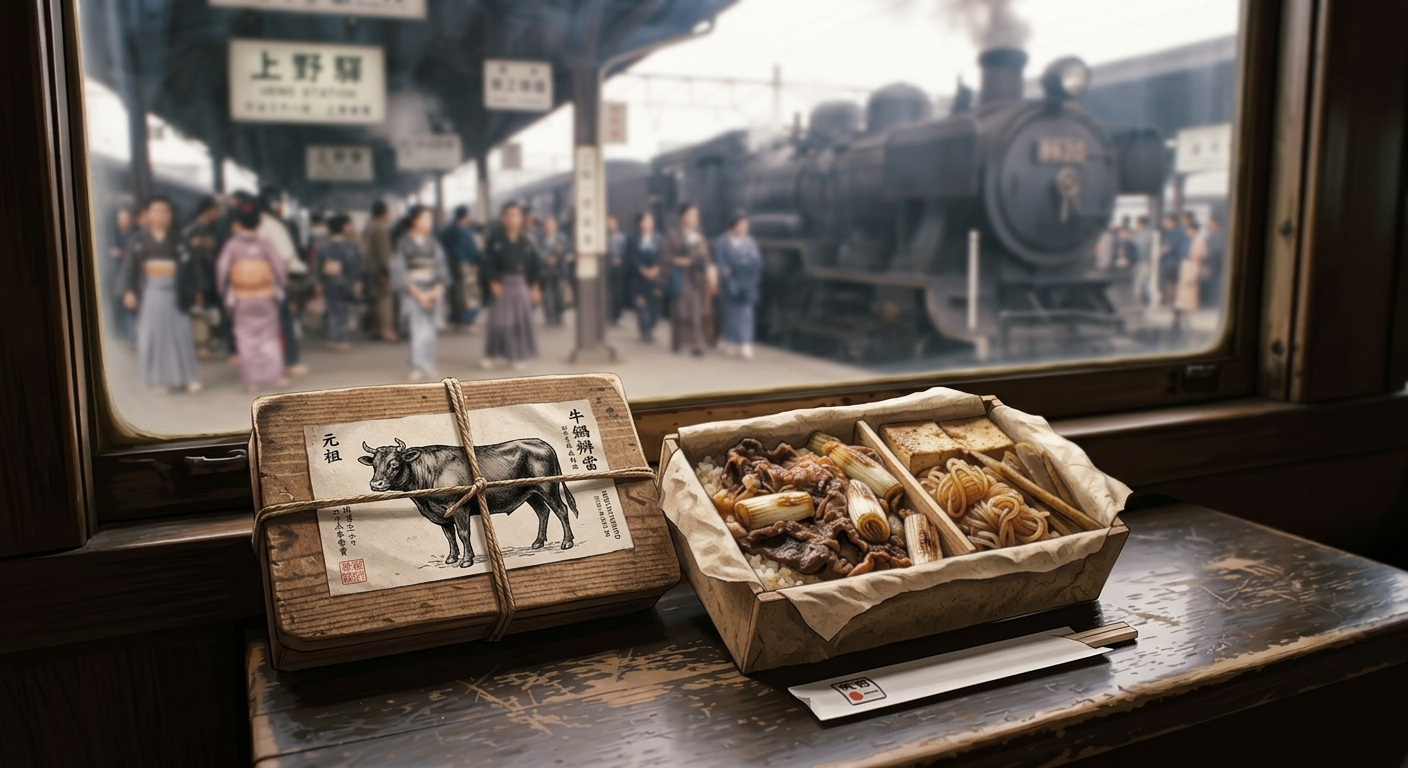
Rengoku’s Beef Hot Pot Bento Cost 36 Sen
In Episode 1 of the TV anime Demon Slayer: Kimetsu no Yaiba – Mugen Train Arc, there is a scene where bento are sold at the train station.
If you look closely at the counter where the bento are sold, you can see the prices.
One of them says:
“Premium Beef Hot Pot Bento — 36 sen.”
This is the beef hot pot bento that Rengoku eats.
Beef hot pot, or gyunabe, became popular during the Meiji period as a symbol of the new Western-influenced culture of the time.
Eating beef was still a relatively new custom in Japan, but by the Taisho period, beef dishes had become part of everyday food culture.
And here we see a bento made with beef being sold on a train.
Demon Slayer is, of course, a fictional story. But this scene includes elements that reflect food culture from the Taisho period.
The price makes the scene even more interesting.
A makunouchi bento cost 15 sen in 1917.
Rengoku’s beef hot pot bento, meanwhile, costs 36 sen.
Of course, we cannot directly compare the price in an anime with the actual prices of bento in the Taisho period.
Even so, within the story, the beef hot pot bento is presented as considerably more expensive than an ordinary makunouchi bento.
And Rengoku does not eat just one.
Behind all those enthusiastic cries of “Delicious!” was a surprisingly large food bill.
Ekiben Contains a Taste of the Place
One thing that makes ekiben different from an ordinary bento is the connection to a particular place.
Ekiben often use local ingredients or regional specialties.
Their wrappers and paper labels have also featured local names, scenery, and other images connected to the area.
For travelers, buying an ekiben can be a way to remember the place they visited.
In other words, an ekiben is not simply a meal to fill your stomach.
It can also be a meal that puts the memory of a journey into a box.
As railways allowed people to travel farther, local foods also became known to travelers from other places.
Ekiben contain both sides of this story: the development of travel by railway and the food cultures of different regions.
Ekiben Can Now Be Enjoyed Without Traveling
Today, you can still buy a bento at a station and eat it on a Shinkansen train.
Ekiben have survived into the age of high-speed rail.
But there is something even more interesting.
Ekiben are no longer limited to stations.
In Japan, department stores and other venues sometimes hold special events where ekiben from different parts of the country are sold together.
You can buy an ekiben from Hokkaido in Tokyo.
You can eat an ekiben from Tohoku in Osaka.
You do not even have to visit the place itself to enjoy its local food through an ekiben.
What was once food to eat during a journey has also become food that lets people feel as if they are traveling.
What Is Inside the Box?
The history of ekiben began very simply.
Two rice balls with umeboshi and some pickles.
As the railway system developed, these simple meals gradually became many different kinds of bento.
Today, each region has its own distinctive ekiben.
Rengoku eating bento enthusiastically on a train is, of course, fiction.
But the scene of
getting on a train, buying a bento, and eating it during the journey
has a long history that developed alongside modern Japan.
An ekiben is more than just a boxed meal.
Inside it are the development of railways, people’s journeys, local food cultures, and memories of travel.
Perhaps that is why even today, when we see an ekiben at a station, we feel a little bit like we are about to go somewhere.
References
- Hayashi, Junshin, and Shinobu Kobayashi. Ekiben Gaku Koza [A Guide to the Study of Ekiben]. Shueisha Shinsho, 2000.
- Edited by Tomoyuki Hashima. Meiji, Taisho, and Showa Ekiben Label Encyclopedia. Kokushokankokai, 2014.
- Edited by Asahi Shimbun. A History of Prices and Popular Life in the Meiji, Taisho, and Showa Periods. Asahi Shimbun, 1981.