The Poet Drawn to ”Spring and Asura”
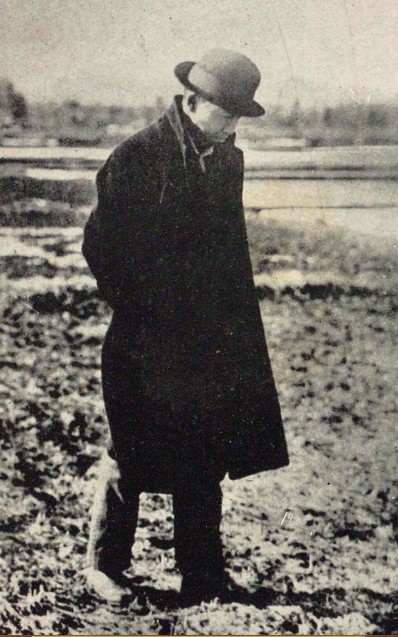
Chūya Nakahara is the poet best known for the haunting line:
“Soiled by this sorrow…”
The image we often have of Nakahara is of a lonely poet surrounded by alcohol, literature, and turbulent episodes—including his famous quarrels with Osamu Dazai.
But Nakahara was also an avid reader of contemporary literature, with a keen interest in the work of other poets.
And among the writers who caught his attention was a rather unexpected name:
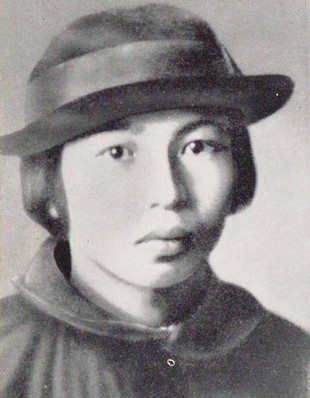
Kenji Miyazawa.
Nakahara loved reading Miyazawa’s poetry collection Spring and Asura.
And he did not keep that enthusiasm to himself.
He bought several copies and took them to his friends.
The essays Nakahara left behind reveal a side of him that might almost be called a “Kenji fan.”
The Spring and Asura Nakahara Loved
Kenji Miyazawa’s Spring and Asura was published in 1924.
Miyazawa described his poetry as “mental sketches”—works in which nature, light, sound, and the surrounding landscape are transformed through his intensely personal perceptions.
In 1935, Nakahara wrote an essay titled “On the Publication of the Complete Works of Kenji Miyazawa.”
There, he wrote:
“I have loved reading his collection, Spring and Asura, for ten years.”
He went even further, calling it an “astonishing collection of poetry.”
Nakahara also described Miyazawa’s work as something close to “our sensibility.”
For Nakahara, Spring and Asura was not simply a collection of poetry that happened to attract his attention.
It was a book he had continued to read and love for years.
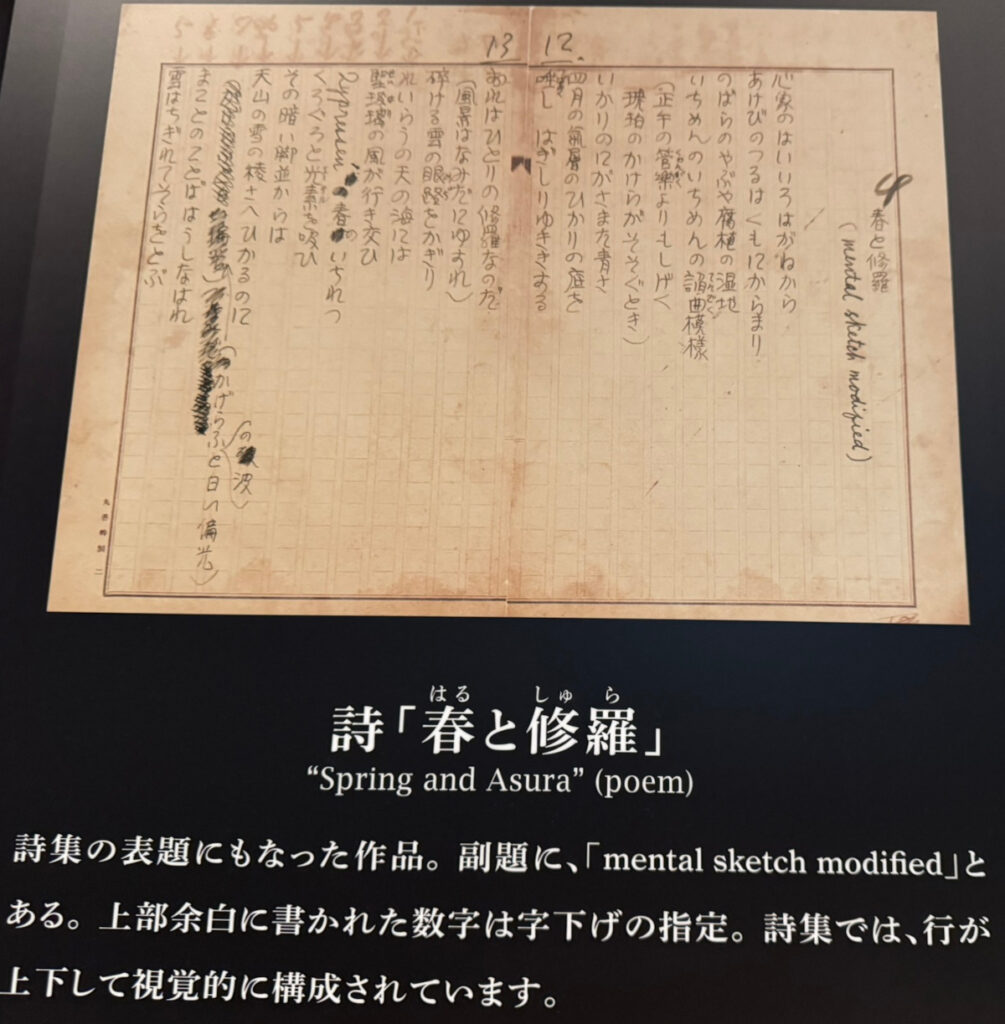
Chūya called Spring and Asura “an astonishing collection of poetry.”
The original manuscript can be seen at the Miyazawa Kenji Memorial Museum in Iwate, Japan.
“This Book Became One of My Favorite Books”
There is another essay in which Nakahara wrote about Miyazawa: “The Complete Works of Kenji Miyazawa.”
In it, Nakahara recalled when he first encountered Spring and Asura.
He wrote that it was “toward the end of 1925, or perhaps the beginning of the following year.”
He could not remember the exact date. He only remembered that it was during the cold season.
And then he wrote:
“From then on, this book became one of my favorite books.”
In other words, Nakahara encountered Spring and Asura when he was around eighteen or nineteen, and it remained a favorite of his.
He Bought Several Copies and Took Them to His Friends
And this is perhaps the most delightful detail.
Nakahara continued:
“I bought several copies and took them to my friends.”
It would be easy to summarize this by saying that he “recommended the book to his friends.”
But the original is more vivid.
He actually bought several copies of Spring and Asura and carried them to his friends.
Perhaps he wanted other people to read a book that he himself had fallen in love with.
And the fact that he specifically wrote that he bought “several copies” makes the image all the more charming.
For Nakahara, Spring and Asura was not simply a book to keep on his own shelf.
It was a book he wanted to place in the hands of his friends.
We tend to associate Chūya Nakahara with turbulent relationships, alcohol, and loneliness.
Yet here we find another Nakahara: a young, enthusiastic reader who discovered a book he loved and wanted to share it with the people around him.
What Did Nakahara Find So Fascinating About Miyazawa?
So what was it about Spring and Asura that captivated Nakahara?
This is where we should be a little careful.
Nakahara never clearly explained, “This is the part of Miyazawa’s poetry that attracted me.”
But he did call Spring and Asura an “astonishing collection of poetry,” and described Miyazawa’s work as something close to “our sensibility.”
Scholarly studies of Spring and Asura have examined Miyazawa’s idea of the “mental sketch”—his distinctive way of transforming natural phenomena and landscapes through perception and sensation.
Light, sound, wind, sky, plants.
In Miyazawa’s poetry, it is not only what the eye sees that becomes poetry, but also the sensations that arise from it.
Perhaps this was part of what Nakahara found so compelling.
Still, it would be too strong to claim that Nakahara was directly influenced by Miyazawa.
Their poetry is, after all, distinctly different.
For now, it may be best simply to take Nakahara’s own words seriously: he felt a strong affinity with Miyazawa’s work.
For Nakahara, Spring and Asura Was a Book He Had Loved for Years
Kenji Miyazawa died in 1933.
Two years later, Nakahara wrote about him.
There, he revealed that he had loved reading Spring and Asura for ten years.
In another essay, he looked back on the moment he first encountered the book and wrote:
“From then on, this book became one of my favorite books.”
And he bought several copies and took them to his friends.
Put together, these details show us something important.
For Nakahara, Kenji Miyazawa was not simply a great poet who had died and was later rediscovered.
He was a poet whose work Nakahara had encountered when he was young—and continued to love for years.
Seeing Chūya Nakahara a Little Differently
When we look into the lives of literary figures, it is easy to focus on their most famous episodes.
With Chūya Nakahara, there is the poem “Soiled by this sorrow…”
And then there are his quarrels with Osamu Dazai.
Of course, those stories are part of Nakahara too.
But so is the Nakahara who bought several copies of a poetry collection he loved and carried them to his friends.
Perhaps small actions like this tell us something more intimate about what a person truly loved.
For Chūya Nakahara, Spring and Asura was one such book.
A collection of poetry he loved enough to write, “I have loved reading it for ten years.”
A book he bought in several copies and carried to his friends.
And perhaps that is why, when we open Spring and Asura today, the poems seem to glow a little differently—
like minerals catching the light, or distant stars scattered across the night sky.
References
- Nakahara Chūya, “Miyazawa Kenji Zenshū” [The Complete Works of Miyazawa Kenji]. First published in Miyazawa Kenji Kenkyū, no. 1, April 20, 1935. Edition consulted: Shinpen Nakahara Chūya Zenshū, Vol. 4, Essays and Fiction, Kadokawa Shoten, 2003.
- Nakahara Chūya, “Miyazawa Kenji Zenshū Kankō ni Saishite” [On the Publication of the Complete Works of Miyazawa Kenji]. First published in Sakuhin, New Year issue, 1935. Edition consulted: Shinpen Nakahara Chūya Zenshū, Vol. 4, Essays and Fiction, Kadokawa Shoten, 2003.
- Ikegawa, Keiji. “An Analysis of Spring and Asura (First Collection), Part 1: Chapter One, ‘Spring and Asura.’” Bulletin of Osaka Kyoiku University, Division I: Humanities, Vol. 29, Nos. 2–3, 1981, pp. 89–100.