In my previous article, I introduced the story of the Shiba Inu, which once came close to extinction.
But what about the dogs that helped carry the Shiba Inu into the future?
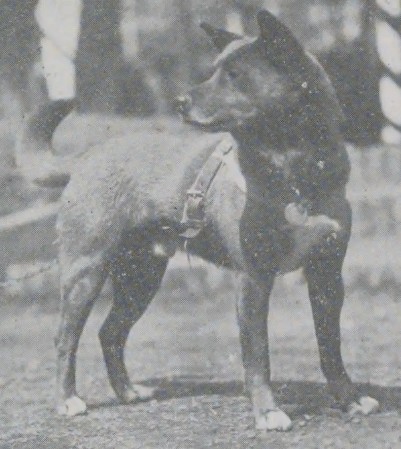
One of them was Ishigo.
Ishigo was born in 1930 in the mountain area of what is now Mitocho, Masuda City, Shimane Prefecture.
At the time, Ishigo was not a famous dog at all.
He lived with a hunter named Shinichi Shimoyama and worked as a hunting dog in the mountains.
He was simply an ordinary hunting dog.
But his life was about to change.
From the Mountains to Tokyo
In the early Showa period, people in Japan began working to preserve the native Japanese dogs that were still living in different parts of the country.
Ishigo was found by Tsurukichi Nakamura, who was studying Japanese dogs in various regions.
In 1936, when Ishigo was five years old, he was brought from Shimane to Tokyo. At the time, this was called yamadashi, meaning that a dog was brought out from its mountain home.
Ishigo had lived with a hunter and worked in the mountains.
Now, he was going to Tokyo as a dog whose bloodline would be preserved as part of the Japanese dog preservation movement.
Ishigo was registered with the Nippon Ken Hozonkai, the Association for the Preservation of the Japanese Dog, and his bloodline continued through breeding.
And this is where Ishigo’s family story began.
From Ishigo to the Next Generation
Ishigo had descendants.
One of the best-known was Aka.
The bloodline continued through the following generations:
Ishigo → Aka → Beniko / Aka No. 2 → Naka
One dog passed its blood to the next.
Then the next dog passed it on again.
Generation after generation, Ishigo’s bloodline continued.
Of course, today’s Shiba Inu did not all come from one dog.
There were many different local Japanese dog lines throughout Japan, and these were preserved in different ways.
Among them, the bloodline connected to Ishigo played an important role in the history of the Shiba Inu we know today.
Finding Ishigo Again
But there is another interesting part of Ishigo’s story.
Decades after Ishigo had lived and died, people began trying to find out where this famous dog had originally come from.
They searched old records, followed references in books and documents, and spoke with people connected to Ishigo’s history.
Little by little, their research led them back to the Shimoyama family, the family who had once lived with Ishigo.
After following the history of a Shiba Inu bloodline, they eventually arrived at a small mountain community in Shimane.
Ishigo was no longer just a name on a pedigree.
There was a place where he had actually lived.
Ishigo’s Name Lives On
The house where Ishigo lived with the Shimoyama family still remains today.
More than 90 years have passed since Ishigo was born in 1930.
And yet, his name has not been forgotten.
His story is still remembered in his hometown.
On November 2, 2026, the Shiba Inu no Sato Festival 2026 will be held in Mitocho, Masuda City, Shimane Prefecture.
November 2 is Ishigo’s birthday.
He would be 96 years old this year.
A hunting dog born in the mountains is still being remembered in his hometown 96 years later.
There is something a little mysterious about that.
Ishigo himself is long gone.
But his bloodline continued through his descendants.
And there were people who did not forget his name.
A dog’s life may end, but the story of that dog does not always end with it.
That is the story of Ishigo.
References
- Nihon Ken Hozonkai (The Association for the Preservation of the Japanese Dog), “History of Nihonken”
- Nihon Ken Hozonkai (The Association for the Preservation of the Japanese Dog), “Shiba Inu”
- Mitocho Tourism Association, “Ishigo, the Ancestor of the Shiba Inu”
- Sekishuken Research, “Books and Literature Research”