There was once a pastime in Japan in which people competed over the songs of their pet birds.
People brought their birds together and compared which one had the better song. This was known as naki-awase or kotori-awase—literally, “Naki-awase” or “song-matching.”
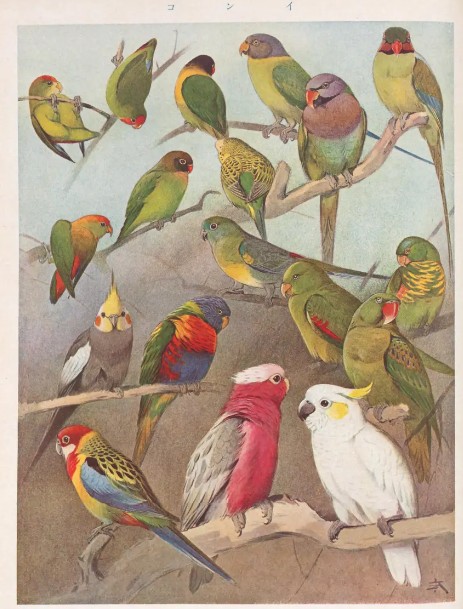
It may seem a little surprising today, but during the Edo period, keeping small birds became popular, and the culture of enjoying pet birds spread among ordinary townspeople.
People raised birds they were proud of and enjoyed listening to their songs.
Naki-awase was one of the pastimes enjoyed by bird lovers in Edo.
Naki-awase Began as an Aristocratic Pastime
The history of Naki-awase goes back a long way. In the Heian period, aristocrats enjoyed games in which they competed over the songs of birds.
These games were part of a broader tradition known as mono-awase, in which people brought together similar things and competed to decide which was better.
At the residence of Emperor Go-Shirakawa, for example, there was a competition called hiyodori-awase, in which the songs of Japanese bulbuls were compared.
At that time, however, Naki-awase was mainly a pastime of the court.
It was during the Edo period that the enjoyment of keeping birds and listening to their songs spread more widely among the people of the towns.
Keeping Small Birds Became Popular in the Edo Period
During the Edo period, keeping small birds became popular among ordinary people as well.
Birds such as bush warblers and quails were especially appreciated for their songs.
As more people began keeping birds, shops selling birds naturally appeared as well.
Small birds were no longer something enjoyed only by people of high status. They had become familiar companions and a source of pleasure for people living in Edo.
And as the number of bird keepers grew, so did the desire to compare their birds’ songs.
Which bird had the better voice?
How well could your own bird sing?
Listening to and comparing birds became part of the fun.
Raising a Bird with a Good Voice
During the Edo period, birds such as bush warblers and quails were popular for their songs.
Quails were particularly popular, and competitions known as uzura-awase were held to compare their calls.
People did not simply keep birds for the pleasure of having them around.
They chose good singers, raised them carefully, and brought them together to compare their songs.
In this way, keeping birds developed into a pastime that involved competition.
The quality of birds could even be ranked in a format similar to a sumo wrestling ranking.
People brought their prized birds together and competed to see which had the better voice.
In modern terms, Naki-awase was perhaps something like a competition held within a hobby community.
Edo Bird Lovers Listened to Songs Very Carefully
The fact that people held song competitions suggests just how carefully they listened to birdsong.
They did not simply judge whether a bird sang loudly or often. They paid attention to subtle differences in the quality of its voice.
Some descriptions of quail songs even used words such as “tone” and “color” to describe their qualities.
Even more interestingly, words associated with “scent” could also be used to describe a bird’s song.
To us today, the idea of a song having a “scent” may sound strange.
But perhaps this shows just how sensitive Edo bird lovers were to the subtle differences in birdsong.
It was not simply a matter of whether a bird sang well.
What did its voice sound like?
What kind of tone did it have?
How did it resonate?
People appreciated these fine differences.
For Edo bird lovers, listening to birdsong was a surprisingly sophisticated hobby.
Naki-awase Continued into the Meiji Period
The culture of keeping small birds that had flourished during the Edo period continued into the Meiji era.
In 1884, a song competition for Japanese white-eyes was held in Kikukawa, Honjo, Tokyo.
The event was organized by Sadataro Murakami, who ran a bird shop in Fukagawa. According to his account, the gathering began with around fifteen or sixteen white-eyes.
The bird-keeping culture that had spread through Edo continued in Tokyo after the Meiji Restoration.
Keeping, Raising, and Competing
The history of Naki-awase shows us how people in the past enjoyed keeping birds.
What had originally been a pastime of the aristocracy eventually became popular among ordinary townspeople during the Edo period. People raised their own birds, compared their songs, and competed over which birds were the best singers.
Small birds were not simply kept in cages for people to look at.
Raise them.
Listen to them.
Compare them.
And show them to others.
That was one way people in Edo enjoyed their birds.
Naki-awase, which had its roots in the court culture of the Heian period, became a pastime enjoyed by townspeople over the centuries and continued into Meiji-era Tokyo.
People gathered around the songs of tiny birds, listened closely, and competed with one another.
Thinking about that makes the streets of Edo and Meiji Tokyo feel just a little closer to us.
References
- National Diet Library, “Birds and Our Lives: A History”
- Hiroaki Hosokawa, Oedo Kaichō Sōshi: Edo no Petto Būmu [The Great Edo Bird-Keeping Book: The Edo Pet Boom], Yoshikawa Kobunkan, 2006.
- Tsunanori Wada (Iban Ryōjin), ed., Nihon Aichōka Danwaroku, Vol. 2, 1907, p. 65.