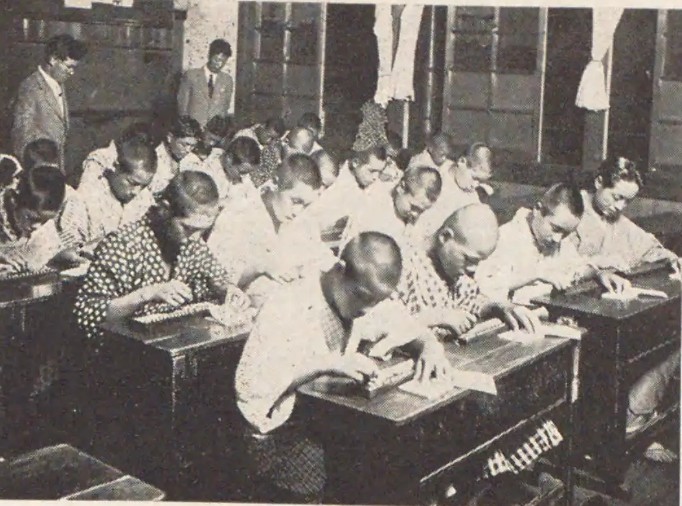
When we look at photographs and illustrations of Japan from the Meiji, Taisho, and early Showa periods, we often see boys wearing school uniforms.
But did all boys go to school in those days?
Actually, no.
As Japan developed its modern school system, more children began to receive elementary education. However, only a limited number of boys continued on to middle school or higher education after finishing elementary school.
In other words, boys of the same age could have very different lives. Some continued studying at school, while others helped their families or went to work.
So, How Old Were Boys When They Went to School?
Today in Japan, most children enter elementary school, middle school, and high school at roughly the same ages.
But Japan’s school system changed many times during the Meiji, Taisho, and early Showa periods.
The school system charts in the Ministry of Education’s Hundred-Year History of the School System show how the types of schools, years of study, and entrance requirements changed over time.
As a general guide, for boys in the late Meiji and Taisho periods, the following ages give us a rough idea.
The school system in modern Japan differed significantly for boys and girls. Here, we will focus on the educational path for boys.
| School | Approximate age |
| Elementary school | About 6–12 |
| Middle school | About 12, for five years |
| Higher school | About 17–20 |
| University | Around 20 and older |
These are only rough estimates.
For example, after a revision to the Middle School Order in 1899, middle schools were defined as institutions providing higher general education for boys, with a five-year course.
This was quite different from today’s middle schools. So when we see the word “middle school” in historical sources, we should not automatically imagine the same kind of school that exists in Japan today.
Did Everyone Go to Middle School After Elementary School?
This is one of the biggest differences from modern Japan.
By the end of the Meiji period, more than 95 percent of children were enrolled in elementary school.
However, about 80 to 90 percent of elementary school graduates did not continue on to secondary education. Family finances were one factor behind this.
In other words,
“Many children went to elementary school”
did not mean
“Many children went on to middle school.”
Education beyond elementary school was still a path open to only a limited number of boys.
Their lives could change greatly depending on their family situation, where they lived, and what path they chose.
What Did Boys Do If They Did Not Continue to Middle School?
So what happened to boys who finished elementary school but did not go on to middle school?
There was no single answer.
Some helped with the family business, while others worked in agriculture.
In cities, some boys entered shops and learned their trade while working.
In shops in the late Meiji period, boys around the age of ten could enter as kozō or apprentices. They might clean the shop and take care of goods while learning the skills needed for a trade or business.
Some boys also worked in factories.
From the late Meiji period into the Taisho period, child labor itself became a social issue. The Nihon Rōdō Nenkan (Japan Labor Yearbook) published during the Taisho period even included sections on the “child labor problem.”
In 1911, Japan passed the Factory Act, which introduced certain restrictions on the employment and working hours of young workers.
However, the law initially applied only to certain factories, such as those employing 15 or more workers on a regular basis.
In other words, working boys were not unusual. Rather, as Japanese society became more industrialized, how society should treat young workers became a new social question.
Some Boys Worked and Studied at the Same Time
There is another important point here.
The choice was not simply between “going to school” and “working.”
In 1893, Japan established a system of supplementary vocational schools. These schools provided education for young people who had finished elementary school and were already working.
Agricultural supplementary schools became especially important in rural areas. There were also supplementary schools for industrial, commercial, and fishing-related education.
From the late Meiji period into the Taisho period, youth associations also spread across Japan and became connected with education for working young people.
Even if a boy could not attend school every day, there were gradually more opportunities to continue learning while working.
At Age 15, Boys Could Follow Very Different Paths
When we look at these different paths, we can see that the word “boy” tells us very little about what a person’s life was actually like.
Two boys who were both 15 might be:
- studying at a middle school
- helping with the family business
- learning a trade at a shop
- working in agriculture
- working in a factory
- working while receiving supplementary education
Their lives could be very different depending on their family, region, and period.
So when we think about boys in modern Japan, we cannot simply imagine that “boys in the old days were all students.”
Being a “Student” Was Something Special
This also helps us understand why students became such a distinctive group in modern Japan.
Going on to middle school or higher education was not an ordinary path for every boy.
Boys who continued their education were still a relatively small group in Japanese society at the time.
They did more than study. At school and in dormitories, they spent time with friends, read books, played sports, and took part in school events.
Over time, distinctive student cultures developed, including school traditions, student slang, clothing styles, and bankara culture.
The images that come to mind when we think of “male students in old Japan” belonged to this particular world of boys who had continued their education.
At the same time, other boys of the same generation were growing toward adulthood through work or family businesses rather than through school.
The lives of boys in modern Japan did not exist only inside schools.
There were boys who continued their education, and boys who grew up through work.
By looking at both, we can get a more complete picture of what it meant to be a boy in modern Japan.
References
- Ministry of Education, Hundred-Year History of the School System in Japan, “School System Charts.”
A basic source for understanding school types, years of study, and entrance requirements from the Meiji period onward. - Ministry of Education, Hundred-Year History of the School System in Japan, “Development of Youth Education.”
A source on supplementary vocational schools and education for working young people. - Osamu Saito, “Child Labor in Modern Japan: A Comparative Quantitative Historical Study,” The Economic Review, 46(3), 1995.
A research paper on child labor in modern Japan. - Osaka City Social Affairs Department, Japan Labor Yearbook, various editions.
A contemporary source for the child labor issues discussed during the Taisho period.