In Aya Koda’s novel Kimono, the mother of the main character, Rutsuko, becomes ill. Rutsuko and her grandmother hurry to make a yukata for her.
The grandmother thinks that when someone in the family is sick, another urgent task may come up the next day. So she decides to finish the yukata that very day.
Making something by hand for a sick family member was once part of everyday life.
Today, this may seem like a distant world. But in the past, sewing skills were closely connected to daily life. People made and repaired clothes at home.
Today, if we needed a yukata for someone who was sick, we might simply buy one. But in the past, ready-made clothes were not as common as they are today. It was normal for families to make clothes at home or alter clothes they already had.
So where did women learn these sewing skills?
When we hear the word “female student” in Japan, we may imagine a young woman wearing a hakama skirt and a ribbon in her hair.
But what did these girls actually study at school?
You might imagine that they spent most of their time sewing. However, the curriculum of girls’ schools included many different subjects, such as Japanese, mathematics, history, geography, science, and foreign languages.
And when we take a closer look at the school timetable, something surprising appears.
They spent a lot of time learning sewing.
Let’s Look at a Meiji-Era School Timetable
The “Regulations for Higher Girls’ Schools,” established in 1895, listed the subjects and number of class hours for higher girls’ schools.
The exact schedule varied depending on the grade and course. In one example, the weekly timetable included the following:
| Subject | Hours per week |
| Japanese | 5 hours |
| Sewing | 5 hours |
| Physical Education | 3 hours |
| Moral Education | 2 hours |
| Mathematics | 2 hours |
| Calligraphy | 2 hours |
| Science | 1–2 hours |
History, geography, home economics, and other subjects were also included depending on the grade.
So sewing was not simply a small practical subject that girls learned at school.
In this particular course, sewing had the same five hours per week as Japanese. It was a major part of the school timetable.
Of course, education at girls’ schools was not only about sewing.
Students also studied mathematics, science, history, and geography. Some schools also taught foreign languages.
Behind the familiar image of girls in beautiful hakama outfits was a much wider range of study.
Why Did They Spend So Much Time on Sewing?
Why, then, was so much time devoted to sewing?
At girls’ schools of the time, sewing was not simply a hobby. It was considered an important practical skill for women to learn.
Making and repairing clothes for themselves and their families was closely connected to everyday life.
And sewing was more than simply putting a needle through cloth.
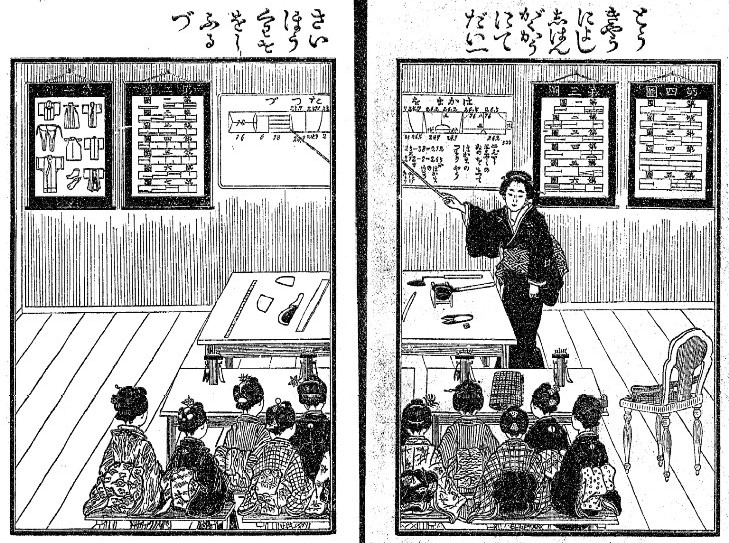
In sewing classes, students learned how to handle fabric, take measurements, cut cloth, and sew garments. They gradually learned the skills needed to make clothes.
One source that helps us understand sewing education at the time is Tachinui no Oshie by Tatsugoro Watanabe.
Published in 1885 and 1886, the book was a sewing textbook that explained practical methods for cutting and sewing fabric to make clothes.
In the sewing classroom, students did not simply read about these techniques. They would actually handle fabric and work with needles and thread.
Sewing Was a Skill for Making and Maintaining Clothes
Let’s step away from the modern meaning of the word “sewing” for a moment.
Today, when we need clothes, we can simply buy them. If something is torn or no longer fits, we can replace it.
But when making clothes at home was much more common, sewing was an everyday skill that supported family life.
Kimono could be altered by changing the way they were sewn together. They could also be taken apart, washed, and made up again.
This way of using clothes for as long as possible helps us understand how closely sewing was connected to everyday life.
Children grew, and their clothes sometimes needed to be altered.
Families made new clothes when they needed them, and old clothes could also be reused for other purposes.
That is why sewing was not simply a useful skill to have. It was a practical skill that was part of everyday family life.
The scene in Kimono, where Rutsuko’s grandmother hurriedly makes a yukata for her sick daughter, gives us a glimpse of this kind of life.
Girls’ Schools Were About More Than Sewing
In reality, female students studied many different subjects.
Japanese, mathematics, history, geography, science, and physical education.
Some schools also taught foreign languages.
In other words, girls’ schools had both classrooms for learning academic knowledge and classrooms for learning practical skills for everyday life.
The girls in hakama may look as though they were enjoying a glamorous school life.
But when we open their school timetable, we find not only Japanese and mathematics textbooks, but also hours spent using needles and thread.
And the sewing skills they learned did not end at the school gate.
They could make and repair clothes for their families and use those skills in everyday life.
The needle and thread they learned to use at school could become part of their lives after graduation.
So, What Did Female Students Learn?
The answer is much more varied than we might imagine from the familiar image of girls in hakama.
They learned knowledge by opening textbooks.
But they also spread out pieces of cloth, took measurements, and moved needles through fabric, learning practical skills with their own hands.
References
- Watanabe, Tatsugoro. Tachinui no Oshie I (Instruction in Cutting and Sewing), Shimizu Uzaburo, 1885–1886. National Diet Library Digital Collections.
- Ministry of Education. Regulations for Higher Girls’ Schools, 1895.
- Sekiguchi, Fusa. Joshi Kyoiku ni okeru Saiho no Kyoikushi: Edo・Meiji Ryō Jidai ni okeru Saiho Kyoiku wo Chushin Toshite (A History of Sewing Education in Girls’ Education: Focusing on Sewing Education in the Edo and Meiji Periods), Kasei Kyōikusha, 1980.