Some people may imagine that people in Japan hardly ate bread before the Meiji period.
But the real story is a little more complicated.
Japan had wheat from an early period, and people made many kinds of food from it.
Bread was also introduced to Japan in the 16th century through contact with Portuguese and other Europeans. Later, knowledge of bread-making continued to exist in Japan, including during the Edo period.
In other words, bread was not completely unknown in Japan.
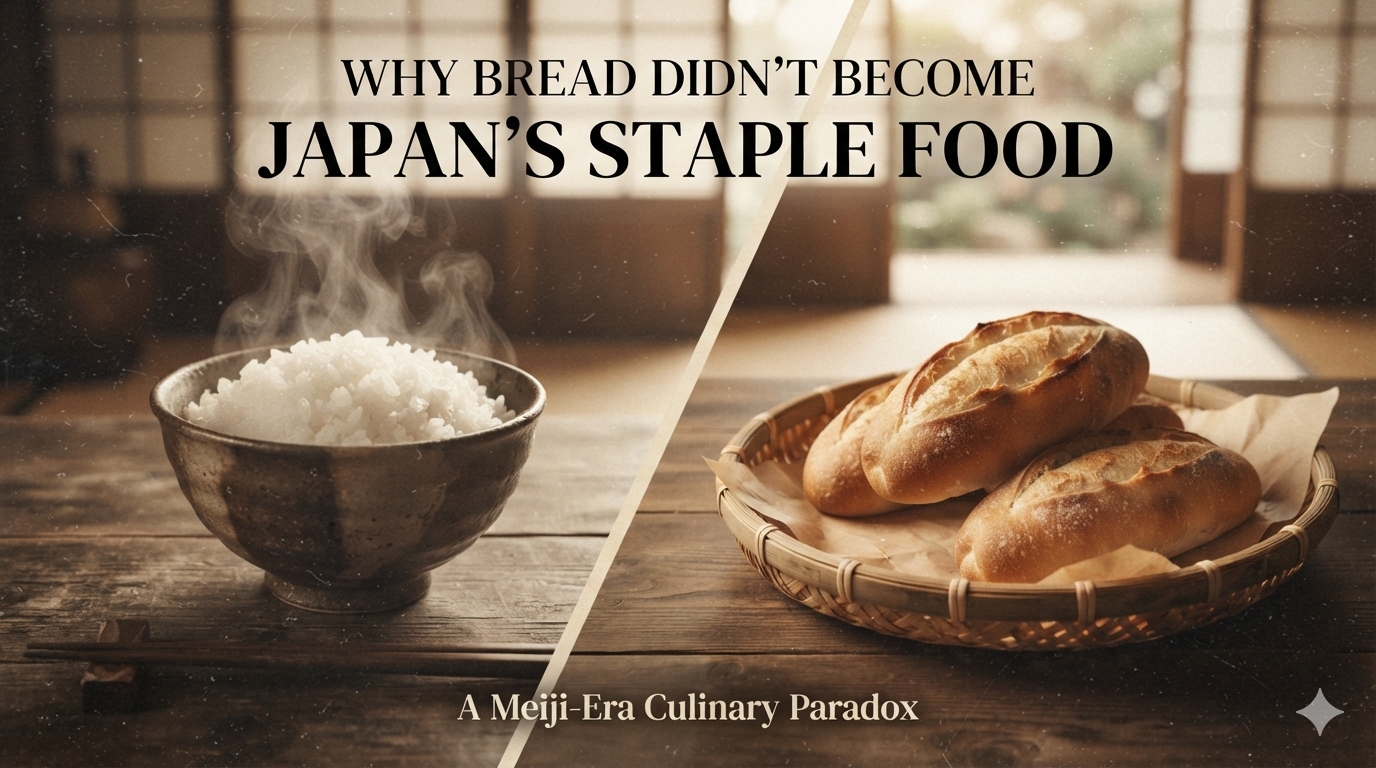
So why did rice, rather than bread, become such an important part of Japanese meals?
Japan Already Had Wheat
First, it would be too simple to say that people in Japan could not make bread because there was no wheat.
Wheat had been grown and eaten in Japan for a long time.
However, wheat was not mainly used for bread.
Wheat flour was used to make foods such as udon and somen noodles, as well as other types of flour-based food.
This is an important point.
Having wheat and making bread from wheat are not the same thing.
The same ingredient can be used in very different ways depending on local food traditions.
In Japan, wheat developed its own place in the food culture.
Shigeru Otsuka’s Bread, Noodles, and the Japanese: Gifts from Wheat is one useful book for understanding this history from the different paths taken by bread and noodles.
Bread Had Already Reached Japan
So when did bread come to Japan?
Bread is generally said to have been introduced in the 16th century through contact with the Portuguese and other Europeans.
However, the arrival of bread did not mean that it immediately became part of everyday Japanese meals.
Relations between Japan and Western countries changed greatly afterward, and bread did not develop in an environment where it could easily become a common food.
Even so, knowledge of bread-making did not completely disappear.
During the Edo period, people in Japan learned about bread-making through contact with foreign countries and made attempts to produce bread.
So the idea that
“Bread was not eaten because Japanese people did not know how to make it”
does not tell the whole story.
Bread was known.
Wheat was available.
And people knew ways to make bread.
Even so, bread did not become a staple food in Japan.
Why?
Japan Already Had a Rice-Based Food Culture
To understand this, we need to look at the whole meal, rather than bread alone.
By the early modern period, rice had an important place in Japanese meals.
This does not mean that everyone in Japan always ate white rice. Food varied greatly depending on the region, social status, and period.
In some rural areas, people also ate barley, millet, potatoes, beans, and other foods. Rice was sometimes mixed with other grains and ingredients to make dishes such as kate-meshi.
Even so, rice played an important role in Japanese food culture.
A meal could be built around cooked rice, with soup and side dishes such as fish, vegetables, tofu, and pickles.
Rice was not simply one kind of grain.
It could serve as the center of the meal.
Wheat, meanwhile, had its own place in Japanese food culture, including noodles and other flour-based foods.
So it was not as simple as saying:
“Japan had wheat, so why not just make bread and eat it as a staple?”
Japan already had an established way of building meals around rice.
For this reason, the arrival of bread did not necessarily mean that bread would replace rice.
Bread Is More Than Just a Food
There is another interesting point here.
A staple food is not determined by the food itself.
It also depends on what people eat with it, how meals are prepared, and what people consider to be a normal everyday meal.
Modern studies of Japanese food culture show differences between meals centered on bread and those centered on rice. The foods and cooking methods used with them are also different.
Of course, these studies focus on modern Japanese eating habits, so we cannot simply apply their findings to the Edo period.
But they give us a useful way to think about the question.
When the staple food changes, the rest of the meal can change with it.
Japan already had a food culture built around rice.
Therefore, the arrival of bread alone was probably not enough to replace rice as the main staple.
Bread’s Role Began to Change in the Meiji Period
The situation began to change during the Meiji period.
Japan adopted many Western technologies, institutions, and aspects of everyday life. Western-style food also became more familiar, especially in cities.
But Japan did not simply copy Western food.
People adapted it to Japanese tastes.
Bread followed a similar path.
One of the best examples is anpan, a sweet bread filled with red bean paste.
According to the Ministry of Agriculture, Forestry and Fisheries, Kimuraya introduced sakadane anpan in 1874. It became popular, and other Japanese-style breads, including jam bread and cream bread, followed.
Interestingly, bread did not first become popular in Japan as an everyday staple.
Sweet breads played an important role in introducing bread to Japanese consumers.
In other words, Japanese people did not simply accept bread exactly as it had come from overseas.
They changed it to fit their own food culture.
When Rice Became Expensive
Bread took on another role when rice became expensive.
According to the Ministry of Agriculture, Forestry and Fisheries, poor rice harvests and rising rice prices in the late Meiji period helped bread become a substitute for rice.
People even developed Japanese-style ways of eating bread, including foods known as tsukeyaki pan and mitsu-pan.
This is an interesting part of the story.
Bread was not simply becoming popular because Japanese people suddenly decided that they preferred Western food.
Economic conditions also affected what people ate.
This is something we can see in many periods of food history.
Bread Was Not “Missing” from Japan
When we ask why bread did not become a staple food in Japan in earlier periods, there is no single simple answer.
It would be difficult to explain the history by saying:
“Japanese people did not know about bread.”
“There was no wheat.”
“They did not know how to make bread.”
Japan had wheat.
People made noodles and other foods from wheat.
Bread was introduced in the 16th century, and bread-making techniques were known in Japan during the Edo period as well.
At the same time, Japan had a long-established food culture in which rice played an important role.
Then, during the Meiji period, changes in Western influence, urban life, food production, and the price and supply of rice created new opportunities for bread.
Japanese people did not simply accept bread as it was.
They adapted it to their own food culture, creating foods such as anpan.
So, why did bread not become a staple food in Japan?
A simple answer might be:
It was not because bread did not exist. Rather, the conditions for bread to become a widely established staple food had not yet developed within Japan’s existing food culture.
But even this should not be seen as the only explanation.
The history of food is connected not only to ingredients, but also to people’s habits, everyday lives, economies, and social changes.
The history of bread in Japan shows how a food from another culture can gradually change as people make it their own.
Bread was not absent from Japan.
In the next article, we’ll look at an event that helped bread spread rapidly in Japan.
References
- Iwao Adachi, The History of Bread in Japan: The Westernization of Food Culture and Japanese Ingenuity, Japan Times, 1989.
- Shigeru Otsuka, Bread, Noodles, and the Japanese: Gifts from Wheat, Shueisha, 1997.
- The Complete History of Japanese Food Culture, Vol. 3: Rice, Wheat, Grains, and Beans, Yuzankaku, 1998.
- Kiyoko Isobe and Yukie Yanagisawa, “Changes in Meals with Bread and Rice as Staple Foods: An Analysis of Cooking Magazines,” Journal of Food Culture Research, Vol. 12, 2016.
- Ministry of Agriculture, Forestry and Fisheries of Japan, “The Development of the Food Industry: Bread and the Fusion with Japanese Food Culture.”