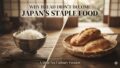
The Rice Riots and Bread on the Japanese Table
“Rice is so expensive.”
It is something we have heard quite often in recent years.
During what has sometimes been called the “Reiwa Rice Crisis,” rice prices rose sharply, and there were times when it was difficult to find rice in stores.
When something essential to our daily meals becomes expensive, we naturally begin to wonder:
“So, what should we eat instead?”
This is not just a modern question.
About a century ago, there was another time when the price of rice rose dramatically.
In 1918, the seventh year of the Taisho era, rice prices soared across Japan.
The situation developed into major social unrest that spread throughout the country.
This became known as the Rice Riots.
And one of the foods that attracted attention as a possible substitute for rice was bread.
So, what did people eat when rice became expensive?
When Rice Became Expensive in 1918
In 1918, the price of rice rose sharply across Japan, becoming a major social problem.
A movement calling for rice to be sold at lower prices began in Toyama Prefecture and eventually spread throughout the country. People in many regions took action over the price of rice, developing into the major social unrest known as the Rice Riots.
When we hear “Rice Riots,” we often think of political and social history as it appears in school textbooks.
But I would like to look at them from a slightly different perspective.
What happened inside ordinary households when the price of rice suddenly rose?
When something essential to everyday meals becomes expensive, household budgets are inevitably affected.
People had to face a very practical question:
“How can we eat for as little as possible?”
When that question arose, bread became one possible alternative to rice.
Why Did Rice Become So Expensive?
So, why did the price of rice rise so sharply in 1918?
There was no single cause. Several different factors overlapped.
During World War I, Japan’s exports increased, and prices in general were rising.
At the same time, demand for rice was increasing, partly because of the growth of urban populations.
Problems with the rice supply, along with speculative activity surrounding rice, added to the situation.
Then, in 1918, preparations for the Siberian Intervention led landlords and rice merchants to buy up rice in anticipation of higher prices, pushing rice prices even higher.
In other words, the rise in rice prices in 1918 cannot be explained simply by saying that “there was not enough rice.”
Changes in the wartime economy, problems involving supply and demand, and various activities surrounding the rice trade all came together to push prices sharply upward.
And it was ordinary households that felt the effects most directly.
Rice was something people needed for their everyday meals.
“If rice is so expensive, what are we going to eat?”
When that question arose, bread became one possible choice.
Bread Did Not Suddenly Appear During the Rice Riots
However, it would be slightly misleading to say that people in Japan started eating bread because of the Rice Riots.
Bread had already become part of Japanese society.
From the Meiji period onward, Western food culture entered Japan, and bakeries began to appear in cities.
Bread was also adapted to Japanese tastes. Anpan, for example, was created by filling bread with sweet red bean paste.
Bread was gradually becoming a familiar food to Japanese people.
And when rice became expensive, bread took on another role.
It could serve as a substitute for rice.
The Ministry of Agriculture, Forestry and Fisheries explains that in the late Meiji period, crop failures and soaring rice prices helped bread take on a role as a substitute staple food.
In other words, bread did not suddenly appear out of nowhere during the Rice Riots of 1918.
It was already there.
Then the reality of expensive rice gave bread another practical reason to be eaten.
Bread Was More Than Just “Haikara”
When we think of bread in early modern Japan, we might associate it with the modernization of Japan and Western culture.
For people at the time, bread could certainly be a new and fashionable food.
Some may have simply wanted to try something unfamiliar.
Others may have been attracted to the idea of a modern, urban lifestyle.
But these were not the only reasons people ate bread.
Because rice was expensive.
Because they wanted to reduce their food expenses.
Because they needed something that could take the place of rice.
In fact, examples of bread being used as a substitute food can be found even before the Rice Riots of 1918.
During the severe crop failure of 1890, bread was valued as a substitute food, and a style of eating called tsukeyaki-pan became popular.
Bread was dipped in a sweet soy sauce mixture and then grilled—a way of adapting bread to flavors familiar to Japanese people.
Bread did not simply enter Japan as “Western food.”
Japanese people adapted it to their own everyday lives, including the way they ate it.
Even So, Rice Did Not Disappear
So, did the Rice Riots lead Japanese people to make bread their staple food?
Of course, it was not that simple.
Rice continued to be at the center of Japanese food culture.
The process by which bread became established in everyday Japanese life involved many different factors, including the development of the flour-milling and baking industries, the spread of Western cuisine, urbanization, and growing interest in nutrition.
The Rice Riots alone did not make bread popular.
Even so, when rice became expensive, bread did take on a practical role as a substitute for rice.
When we look at the history of food, we can see not only culture and fashion, but also the accumulation of small, everyday decisions:
“What are we going to eat today?”
When rice became expensive in the Taisho era, bread was both a fashionable, modern food and a practical substitute for rice.
With these two sides to its identity, bread gradually found a place at the Japanese table.
References
- National Diet Library, Kaleidoscope of Books: Taisho Democracy and the Media
- Ministry of Agriculture, Forestry and Fisheries, The Development of the Food Industry: Bread — The Fusion of Bread and Japanese Food Culture
- The Popularity of Bread as Seen in Newspaper Articles