![Omoto Zukai [Illustrated Guide to Omoto], National Diet Library Digital Collections.](https://retrojpn.com/wp-content/uploads/2026/08/omoto1.jpg)
The Japanese Idea of Renewal
Have you ever heard of a plant called omoto?
In Japanese, its name is written with characters that can be understood as “ten thousand years” and “green.”
The first part, man-nen, refers to an extremely long time—literally, “ten thousand years.”
The second part, ao, can mean blue or green, and here it refers to the fresh green color of the plant’s leaves.
Together, the name suggests something that remains green and fresh for a very long time.
Omoto is not a plant grown for spectacular flowers. What makes it distinctive is its foliage, which stays green throughout the year.
And this ability to remain green even as the seasons change is one reason why omoto came to be regarded as a lucky plant in Japan.
Why Is Omoto Considered Lucky?
Many plants change dramatically with the seasons.
They sprout in spring, grow lush in summer, change color in autumn, and lose their leaves in winter.
Omoto is different.
Even in winter, its leaves remain green.
This evergreen appearance may have reminded people of a life that does not easily fade away.
Over time, omoto became associated with longevity, prosperity, and the hope that a family or household would continue for generations.
Its name reinforces that image.
Always green. Always full of life.
For this reason, omoto came to embody wishes for a long and healthy life and for lasting prosperity.
The Japanese Idea of Tokowaka
To understand omoto a little more deeply, it may be helpful to look at an old Japanese idea known as tokowaka.
The word combines the ideas of constancy and youthfulness, freshness, or newness.
But tokowaka is not simply about never growing old.
It expresses the idea of remaining vital by being renewed.
Rather than allowing something to grow old and gradually decline, it can continue by becoming new again.
One of the best-known examples is the periodic rebuilding of the shrines at Ise Grand Shrine.
Rather than preserving the same buildings forever, the shrine structures are rebuilt at regular intervals.
The old buildings are replaced with new ones, while the rituals, techniques, and traditions associated with them continue.
In other words, something can remain continuous by being renewed.
Of course, an evergreen plant and the rebuilding of a shrine are not the same thing.
Still, they may reflect a similar way of thinking.
Rather than simply resisting age and decline, something precious can continue by preserving its vitality and renewing itself.
Seen from this perspective, omoto’s evergreen leaves take on another meaning.
They may have suggested the hope that life—and the things people value—would continue for a long time.
Around 1882, Omoto Became So Popular That Prices Soared
Historical sources also show just how strongly omoto fascinated people.
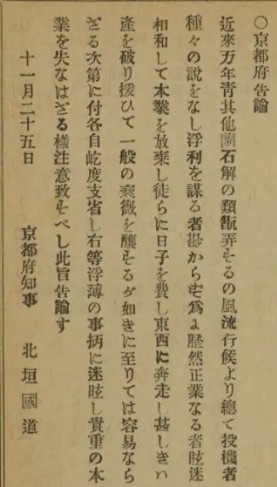
In the December 1882 issue of Nogyo Zasshi, or Agricultural Magazine, a notice from the Kyoto Prefectural Government addressed the soaring prices of omoto.
The prices had risen so dramatically that the authorities felt compelled to intervene.
This suggests that the popularity of omoto had grown far beyond an ordinary interest in gardening.
Of course, it would be too simple to say that omoto became expensive merely because it was considered lucky.
The enthusiasm for rare varieties, the appeal of unusual leaf shapes and patterns, and speculative trading were likely all part of the story.
Even so, the episode shows how powerfully this evergreen plant captured people’s imaginations.
Omoto was not simply a lucky charm.
It was also a plant that people collected, admired, and sometimes became so enthusiastic about that its prices spiraled out of control.
Source:National Diet Library Digital Collections
The Wishes Behind Omoto
The name omoto reflects the plant’s evergreen appearance.
But the name can suggest something more than color.
May it remain green for a very long time.
A plant that stays green.
A person who lives a long and healthy life.
A family that continues and prospers.
These are different things, but they share a similar wish:
May what is precious continue.
That may be why omoto is more than simply an interesting lucky plant.
Its evergreen leaves offer a glimpse of the hopes people have placed in plants for generations—wishes for longevity, prosperity, and a stable life.
Omoto.
An evergreen plant whose name evokes something that remains green for ages.
Perhaps people looked at its unchanging green leaves and imagined a household that would continue to prosper and enjoy a peaceful, stable life.
And perhaps that is what makes omoto so evocative even today: behind its evergreen leaves lies a simple human wish—
that the things we cherish will continue for a very long time.