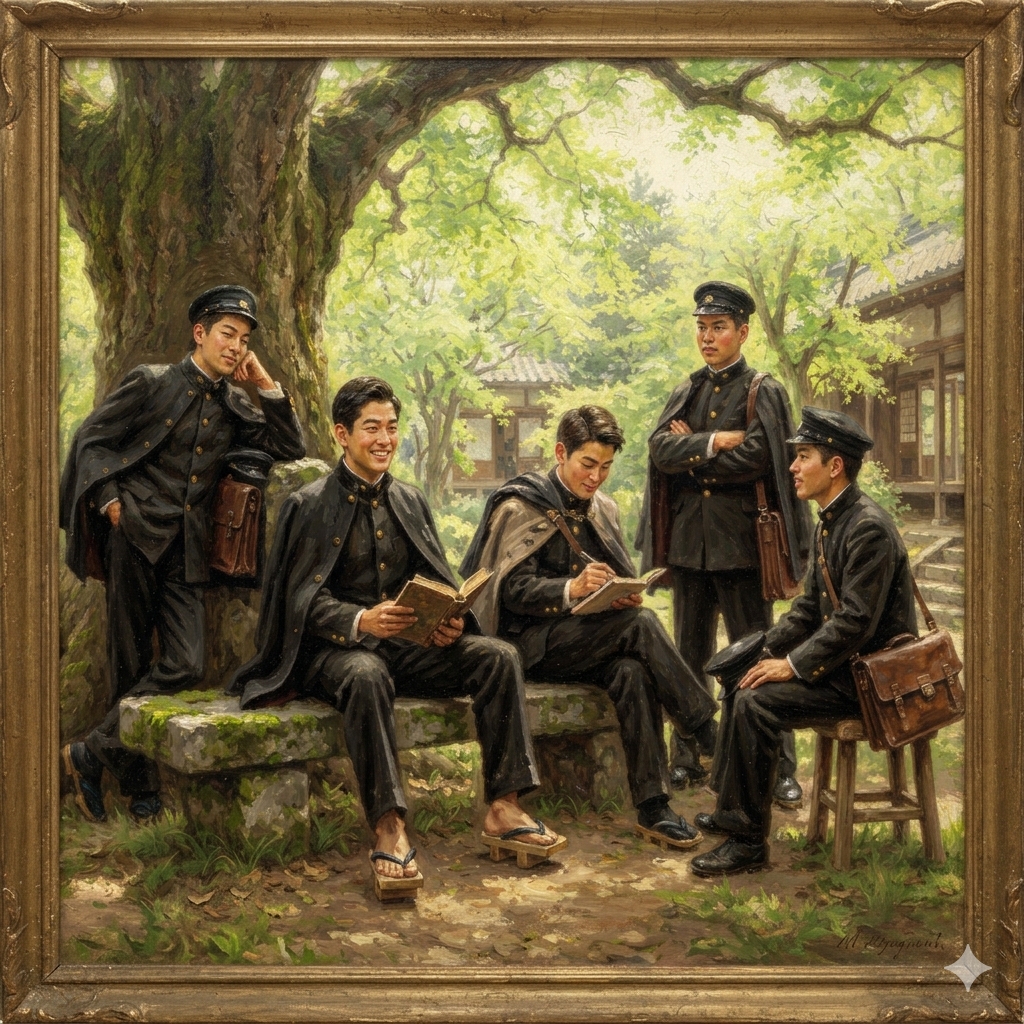
From the Meiji period through the Taisho period and into the early Showa period, more and more boys and young men in Japan began attending schools.
However, we should be careful when we hear the phrase “male students in the past.” It does not represent all young men of that time.
Only a part of the population could continue on to middle school, higher school, or university. As the system of boys’ secondary education developed, the number of middle school students increased. But going to school beyond elementary education was not yet something that all boys could take for granted.
For a general guide, students in middle school were usually in their early teens, while students at former higher schools and universities were older.For more about the age at which boys started school in modern Japan, see this article.
Even so, students gradually became a distinctive presence in modern Japanese society.
What Did It Mean to Become a Student?
In modern Japan, schools became places not only for learning, but also for preparing for future careers and social positions.
Among boys who received education beyond elementary school, some hoped to continue their studies or become professionals, government officials, and other white-collar workers.
At the same time, the meaning of the word “youth” also began to change during the late Meiji period.
Alongside the older image of the ambitious young person who wanted to “make something of himself,” a new image appeared: the “student youth” who was shaping himself through school life and education.
In this sense, a student was not simply a young person who went to school. Students became a new and increasingly visible type of young person in a rapidly modernizing Japan.
Student Culture at School
Student life was about more than studying.
Students spent time with friends at school and in dormitories. They read books, played sports, and took part in school events and activities.
In particular, Japan’s former higher schools, known as kyusei koto gakko, developed their own school cultures. Dormitory life and other shared experiences helped create distinctive traditions and a strong sense of identity at each school.
By the late Taisho and early Showa periods, the number of students receiving higher education had grown. There were also examples of students creating their own organizations and using things such as school songs and cheering songs to build connections among students.
This kind of student culture did not remain entirely inside the schools. It also became recognized by wider society as part of what made students “student-like.”
Student Language and Fashion
Student culture could also be seen in language and clothing.
Words and expressions used among students, popular styles, hats, and school uniforms all helped create a sense of being part of the student world.
One example is bankara, a style that is still remembered today. Bankara students were often associated with a rougher, less fashionable appearance, in contrast to the Westernized style known as haikara.
However, not all male students dressed alike or shared the same ideas.
Student life also differed depending on the type of school, the region, and the period.
That is why it is important not to say simply, “This is what male students were like in the past.” Instead, we can look at the different cultures created by particular groups of students.
On this blog, we will explore the lives of male students in modern Japan from many different angles, including school life, student slang, clothing, and the world of bankara.
References
- Kōtarō Wasaki, “The Formation of the Concept of ‘Youth’ in Modern Japan: From the ‘Ambitious Youth’ to the ‘Student Youth,’” Journal of Human and Environmental Studies, No. 19, 2010.
- Kōtarō Wasaki, “A Reconsideration of the ‘Troubled Youth’ in Modern Japan,” Journal of the History of Education, No. 55, 2012.
- Samon Takahashi, “School Culture in Japan’s Former Higher Schools,” Bulletin of the National Institute for Educational Research, No. 95, 1978.
- Osamu Tomura, “Views of Universities and Students in the Taisho and Early Showa Periods: An Analysis of Articles in Jitsugyo no Nihon.”
- Daiki Hasezaka, “A Study of Student Bond Formation in the Late Taisho and Early Showa Periods.”