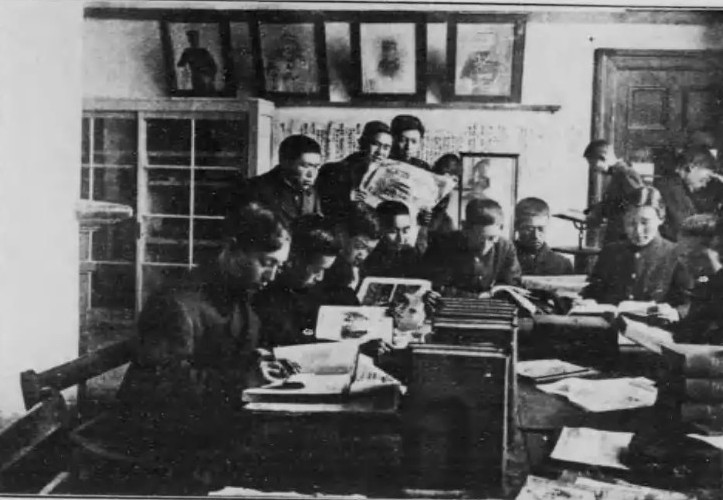
When we look at old photographs of Japan’s Meiji and Taisho eras, students often appear in the streetscape.
Male students wearing stand-up collar uniforms, caps, and carrying school bags.
Female students dressed in hakama trousers, walking with textbooks in their arms.
Today, the existence of “students” feels completely natural. However, in Japanese history, students as a distinct stage of life are actually a relatively modern phenomenon.
Why did this new stage of life emerge in Japan during the Meiji and Taisho periods?
Behind this change was not only the development of the modern school system, but also a major transformation in the way people understood childhood, growth, and becoming an adult.
- Were Children Once Seen as “Small Adults”?
- Modernization and the Discovery of Childhood
- Youth Was Not Simply “Incomplete Adulthood”
- Male Students: Young People Expected to Build the Future
- Female Students: The Birth of a New Image of Women
- Student Culture Created the Idea of “Youth”
- The Birth of Students Changed the Way People Viewed Human Life
- References
Were Children Once Seen as “Small Adults”?
Before modern times, Japanese society had a different understanding of childhood from today.
Of course, children were valued and cared for by their families.
However, the idea that childhood itself was a special period of life that should be protected and dedicated to education was not as strongly established as it is today.
In many cases, importance was placed not only on age, but also on the roles a person could take within their family and community.
Growing up was often understood as gradually becoming a responsible member of society, rather than spending a long period preparing for adulthood.
However, it would be too simple to say that children in the past were merely “small adults.”
Children had their own worlds of play and learning, and they were carefully raised within their families and communities.
The major change in the modern era was the spread of a new idea:
children had their own period of development before entering adult society.
Modernization and the Discovery of Childhood
During the Meiji era, Japan began developing a national school system in order to build a modern nation.
With the Education System Order of 1872, a nationwide school system was introduced, and an era began in which many children studied at schools.
Japan already had places of learning before this period, such as domain schools, private academies, and temple schools during the Edo era.
However, those forms of education were closely connected to local communities, social status, and occupations.
Modern schools created a new kind of space where people from different regions and backgrounds could gather and learn together.
Young people who came from rural areas to cities, and classmates who had grown up in different environments, met one another at school.
There, they began thinking not only about what they had inherited from their families and communities, but also about their own futures.
Schools were not simply places for gaining knowledge.
They became places where young people spent time with their peers, learned from teachers, and imagined the person they wanted to become.
This created a new period between childhood and adulthood.
A time when people did not immediately take on social responsibilities, but instead learned and developed themselves.
This was the birth of youth as a distinct stage of life.
Youth Was Not Simply “Incomplete Adulthood”
The emergence of youth was also a change in the way people viewed human development.
Previously, the process of becoming an adult was often understood mainly as preparation for becoming a full member of society.
However, in modern times, the idea spread that the period of growth itself had value.
Students were not yet adults.
But they were no longer simply children.
They were people who learned, developed their own ideas, and created their future selves.
A new stage of life called “youth” had appeared in Japanese society.
Male Students: Young People Expected to Build the Future
Male students in the Meiji and Taisho periods were expected to support the development of the modern nation.
They received higher education, gained knowledge, and prepared to contribute to society.
Student life was also connected with the idea of achieving success through effort and education.
Young men who left their hometowns to study in cities became symbols of the new era.
Student uniforms and caps were not merely clothing.
They represented being a person who studied and a young person moving toward the future.
However, students did not only experience hope and ambition.
They also struggled with questions such as:
Who am I in this changing society?
How should I live my life?
These concerns became an important feature of the modern Japanese youth experience.
Female Students: The Birth of a New Image of Women
Female students also became symbols of the Meiji and Taisho eras.
As women’s education expanded, more young women began attending girls’ schools.
The image of female students wearing hakama trousers was something new and striking to people at the time.
They represented new possibilities:
- Women who gained education and knowledge
- Women who enjoyed literature and the arts
- Women searching for new ways of living
Of course, society still expected women to become “good wives and wise mothers,” and women’s choices remained limited in many ways.
Nevertheless, female students demonstrated that women, too, could have a period of learning and personal growth.
Girls’ schools were not only places for academic study.
They also became cultural spaces where young women shared language, fashion, interests, and hobbies with their peers.
From these environments grew unique female student trends and literary cultures.
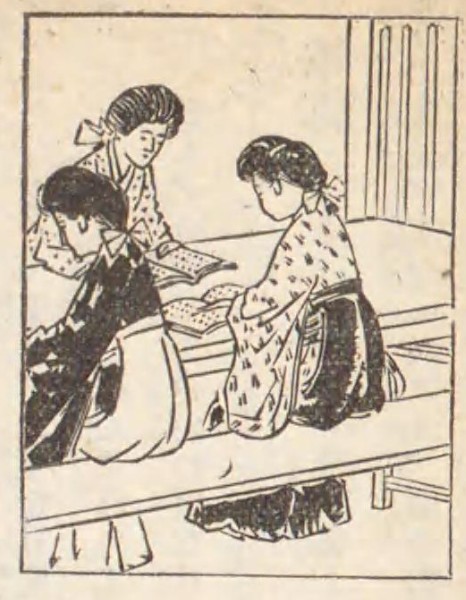
Saishin Nihon Shōjo Hōten (The Latest Treasury for Japanese Girls), edited by Sazanami Iwaya and Fujiji Numata. Seibunkan, 1912.
Source: National Diet Library Digital Collections.
Student Culture Created the Idea of “Youth”
Students of the Meiji and Taisho eras did more than simply attend school.
Friendships, literature, art, romance, and dreams for the future.
Through these experiences, the feeling of “youth” gradually took shape.
Student life was no longer seen as an empty waiting period before entering society.
It became a meaningful and special time within a person’s life.
The Birth of Students Changed the Way People Viewed Human Life
The student culture of the Meiji and Taisho eras was not only a story about schools.
It was also a story about how Japanese people came to understand human growth.
Children were not simply small adults.
Young people were not merely incomplete adults.
Each stage of life had its own meaning and value.
Students of the Meiji and Taisho eras became symbols of modern Japan’s discovery of the importance of time spent growing.
References
・ Wasaki, Kotaro. Youth in Meiji Japan: Ambition, Self-Cultivation, and Inner Struggles. Kyoto: Minerva Shobo, 2017.
・ Kimura, Naoe. The Birth of Youth: The Transformation of Political Practice in Meiji Japan. Tokyo: Shinyosha, 1998.
・Thirty-Five Years’ History of Osaka Municipal Higher Commercial School
Compiled by Osaka Municipal Higher Commercial School
Published by Osaka Municipal Higher Commercial School Alumni Association and others, 1915
Source: National Diet Library Digital Collections